Khamlia Village & Gnawa Music: History, Instruments & How to Visit Respectfully
Most visitors spend less than 20 minutes in Khamlia. They watch a performance, take a few photos, and leave without realising they have just experienced one of Morocco’s most important living traditions. Khamlia is far more than a stop on the way to the Sahara. It is the home of Morocco’s Gnawa music, a spiritual tradition with roots in sub-Saharan Africa that blends music, history, and healing rituals passed down through generations. Knowing the story behind the music completely changes the experience. In this guide, you will learn the history of Gnawa music, recognise the guembri and krakebs, understand local etiquette, know how much to tip, what questions to ask the maâlem (master musician), and how to include Khamlia in your Merzouga itinerary without rushing your visit.
Quick Facts
- Location: Khamlia is 7 km southwest of Merzouga, on the edge of Erg Chebbi dunes
- Population: Around 800 people, many of Gnawa descent
- Best time to visit: Late morning (10–11 AM) or Saturday afternoons for private ceremonies
- Performance duration: 30 to 60 minutes
- Tipping: 20 to 40 MAD ($2 to $4 USD) per person, handed directly to the maâlem
- Dress code: Modest clothing, shoulders and knees covered, loose fit
- Photography: Always ask permission first, no flash allowed
- Main instruments: Guembri (three-stringed bass lute), krakebs (metal castanets), tbel (drum)
- UNESCO recognition: Gnawa music inscribed in 2021 as Intangible Cultural Heritage
- Entry cost: Village entry is free, performance cost is 50 to 100 MAD per person in private settings
All prices in Moroccan Dirham (MAD) and approximate USD equivalents where applicable.
Where Is Khamlia and Why Does Its Gnawa Music Matter?
Khamlia sits 7 kilometres southwest of Merzouga, tucked against the edge of Erg Chebbi. The village has roughly 800 residents, many of Gnawa descent: descendants of enslaved West Africans brought to Morocco via trans-Saharan trade routes between the 16th and 19th centuries. What began as secret healing ceremonies in those communities evolved into Gnawa music, a spiritual practice now recognised on UNESCO’s Representative List of the Intangible Cultural Heritage of Humanity (inscribed in 2021).
Gnawa music is not Moroccan blues, though lazy travel writers call it that. It is a trance ceremony called a lila, performed overnight to heal psychological or spiritual afflictions. The rhythms and chants invoke spirits (mlouk) from the Gnawa cosmology, blending Bambara and Hausa traditions with Berber and Arab elements absorbed over centuries. In Khamlia, you will see a shortened, tourist-friendly version of this ceremony, but even a 30-minute performance carries echoes of the original ritual if you pay attention.
The village hosts a small festival each spring (dates vary depending on local calendar and weather), but performances happen year-round. Visit on a Saturday afternoon if possible. Local families often host private ceremonies then, and the village feels more authentic than during weekday bus tours. Ask your guide to check with the elder musician ahead of time. The maâlem may be tending his date palms or resting, and showing up unannounced feels intrusive. If you are planning a Sahara desert tour and want Khamlia to be more than a 20-minute stop, tell your operator in advance — a private tour makes all the difference here.
The Instruments of Gnawa Music: Guembri, Krakebs, and Tbel
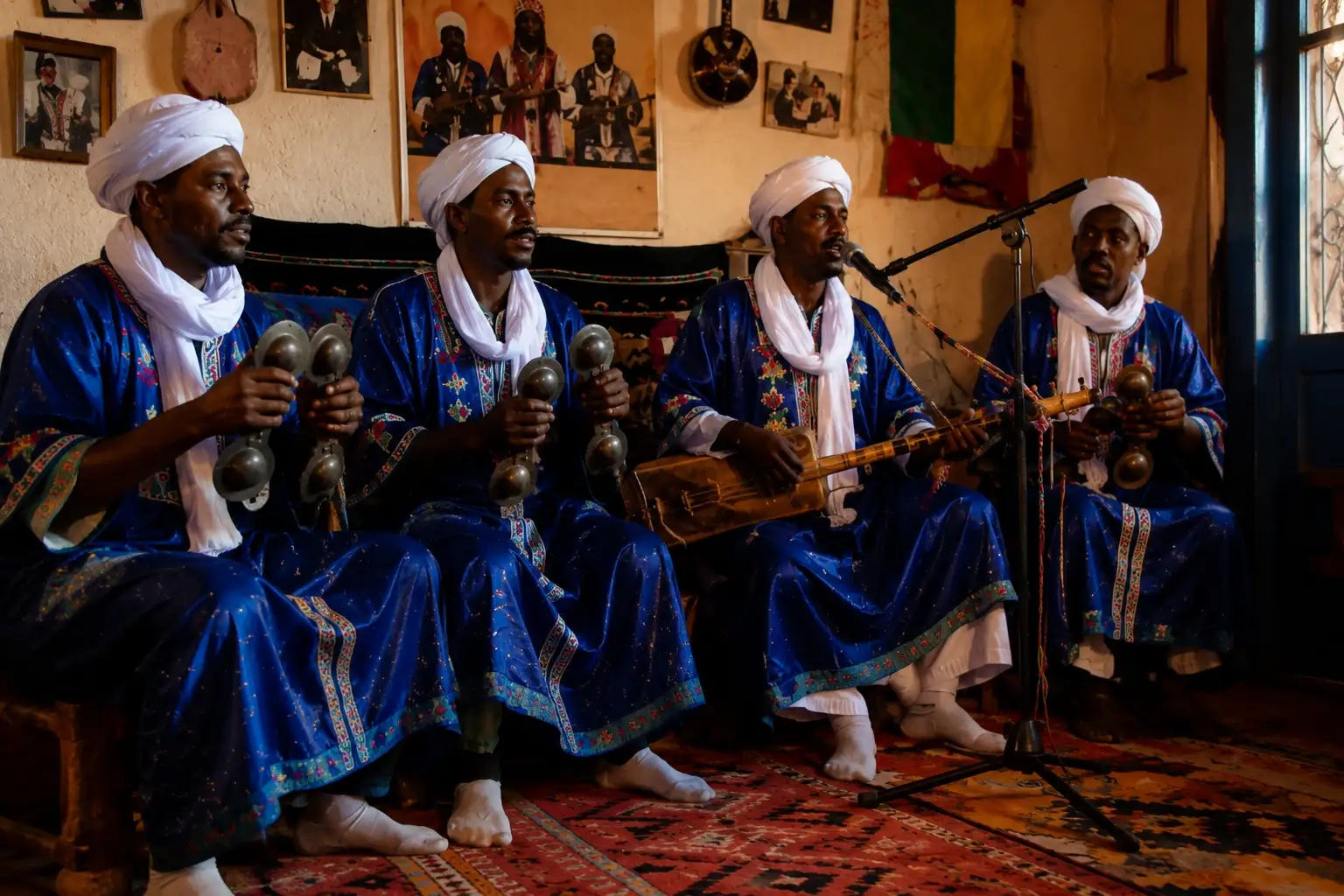
The guembri (also called sintir) is a three-stringed bass lute carved from a single block of apricot or walnut wood, with a skin-covered soundbox made from goat or camel hide. It produces a deep, rhythmic drone tuned to D-A-D with a high octave, creating a hypnotic pulse that underpins the entire ceremony. Only the maâlem plays the guembri. He wears it low on his chest, plucking with two fingers while singing call-and-response chants. The vibration travels through the floor cushions if you sit close enough.
Krakebs (or qraqeb) are large metal castanets, each pair weighing about one kilogram. They are tied together with leather straps and played by two or more musicians who stand and move in synchronised rhythms. The sound is sharp, percussive, and relentless. Krakebs maintain the trance pulse, pushing the tempo forward while the guembri anchors it. The tbel, a double-headed drum played with a curved stick, provides the bass beat in some performances, though not all Khamlia groups use it.
Musicians typically wear white jellabas and skullcaps during performances. If you get a chance, ask the maâlem to let you hold the krakebs. They are surprisingly heavy, and playing them correctly requires wrist strength and timing that takes years to develop. A quick lesson is a memorable interaction, and most musicians will smile at your clumsy attempts. Just do not drop them. They dent easily, and a dented krakeb loses its tone.
How to Visit Khamlia Respectfully: Etiquette and Practical Tips
Performances in Khamlia usually last 30 to 60 minutes in a private home or communal space with concrete floors and floor cushions. You sit cross-legged or with legs folded to the side. Shoes come off at the door. Dress modestly: shoulders and knees covered, loose clothing that will not ride up when you sit on the floor. In summer, light linen is best. The concrete stays cool even when the air outside hits 40°C. For a full picture of what desert temperatures actually feel like at different times of year, our Sahara desert weather guide covers every month with realistic temperature ranges.
Tipping is standard, not optional. Hand 20 to 40 MAD ($2 to $4 USD) per person directly to the maâlem with gratitude after the performance. If you are in a small group, 50 to 100 MAD total is appropriate. Do not bargain. This is not a transaction. The musicians are sharing a piece of their heritage, not selling a souvenir. Arrive with small change in dirhams. Many village musicians do not have card readers, and breaking a 200 MAD note is difficult. Our Morocco trip cost guide covers tipping norms across the country if you want a broader reference for what to carry.
Photography requires permission. Always ask first. Some musicians will pose for a tip. Others prefer to be photographed while playing. Never use flash. It disrupts the trance state and blinds the musicians. Clapping along is welcome if it matches the rhythm, but foot-stomping might be seen as mockery. Avoid asking for specific songs. The performance is improvised, flowing from one piece to the next based on the energy in the room. Watch the locals first. They will show you when to participate and when to simply listen.
Combining a Khamlia Visit with Your Merzouga Desert Tour
Khamlia is ten minutes by car from Merzouga centre. Most tours combine it with camel rides to Erg Chebbi, sunset over the dunes, or a visit to Hassi Labied, the neighbouring Berber village known for its fossil workshops. Private tours can schedule a morning performance (cooler, fewer tourists) or an afternoon session before sunset. Entrance to the village is free. The performance cost is voluntary, typically 50 to 100 MAD per person in a private setting.
A guided visit adds context your ears cannot catch alone. Your guide can interpret the meaning of specific chants, introduce you to the musicians by name, and explain why the maâlem closes his eyes during certain passages. Ask your driver or guide to request a performance that includes the tagnaouite song, a slower, meditative Gnawa genre from Khamlia that is rarely played for mass tourists. It shows a different side of the music: less rhythmic intensity, more spiritual weight.
If you are traveling from Fes or Marrakech to Merzouga, Khamlia fits easily into a multi-day Sahara itinerary. Our 3-day Marrakech desert tour reaches Merzouga on Day 2 with enough time for a late afternoon Khamlia visit before sunset at the dunes. Travelers coming from Fes can reach Khamlia on Day 1 of our 3-day Fes desert tour. Budget 90 minutes total for the village: 15 minutes to drive there, 45 minutes for the performance and tea, 15 minutes to browse the small handicraft stalls near the village square, and 15 minutes to return. Do not rush it. The performance is not background entertainment. It is the cultural heart of this corner of the desert.
What Most Guides Get Wrong About Khamlia
Most travel articles describe Khamlia as a “living museum” or a “cultural village.” This framing is misleading. Khamlia is not a theme park. It is a working village where people farm dates, raise livestock, and happen to carry one of Morocco’s most important musical traditions. The performances you see are adapted for tourists, yes, but the musicians are not actors. They are practising a ceremony their grandfathers performed in private, behind closed doors, when Gnawa music was still considered subversive by outsiders.
Another common mistake: calling all Gnawa music the same. The Gnawa tradition in Essaouira, on Morocco’s Atlantic coast, sounds different from Khamlia’s version. Essaouira Gnawa has more Arab and Andalusian influence. Khamlia’s music retains stronger Berber rhythms and a faster tempo, shaped by its isolation in the desert. If you have heard Gnawa music in Marrakech or Essaouira, you will notice the difference immediately. The tempo pushes harder. The guembri sits lower in the mix. The krakebs dominate.
Finally, many guides claim that joining in the dancing is expected. This is only half true. During certain high-energy sections, the musicians will invite you to stand and move with the rhythm. But if you are unsure, stay seated. Clapping is always safe. Dancing requires you to match the tempo, and if you cannot keep time, you will look foolish. The musicians are too polite to say anything, but you will feel it. Watch the locals first. They will show you when to participate and when to simply listen.
Ready to Listen Beyond the Tourist Beat?
Khamlia offers a rare chance to connect with Morocco’s sub-Saharan roots through music that heals and unites. By visiting with respect and curiosity, you become part of a story much older than any souvenir photo. You also support a community that has chosen to share its heritage rather than hide it, trusting that some travelers will take the time to understand.
Khamlia pairs naturally with the other stops along the desert route. If you are building a longer itinerary that includes the Dades Gorge, Todra Gorge, and Ait Ben Haddou alongside the dunes, our guide to how many days you need for a Sahara tour helps you decide how to pace everything. For those who want the complete Morocco experience from north to south, our 10-day Marrakech, Sahara and Fes tour builds Khamlia into a properly timed private itinerary that does not rush any stop. If you are deciding between routes and starting points, our Fes to Sahara routes guide and Marrakech to Sahara distance guide cover both options in detail.
Our private Merzouga tours are designed to include Khamlia as a genuine cultural experience, not a 20-minute checkbox. We work with local guides who know the musicians personally, schedule visits at the right time of day, and build in enough time for tea, conversation, and a proper performance. Whether you are starting from Marrakech on our 3-day Marrakech desert tour, coming from Fes on our Fes to Marrakech desert tour, or building a longer route with our 10-day Marrakech, Sahara and Fes tour, we design each day to match your pace and interests. Contact us to build your Sahara itinerary.
📩 Contact us: contact@mementomorocco.com | +49 1522 3075977 | WhatsApp