Ait Ben Haddou Guide: UNESCO Ksar, Film History & Visit Tips
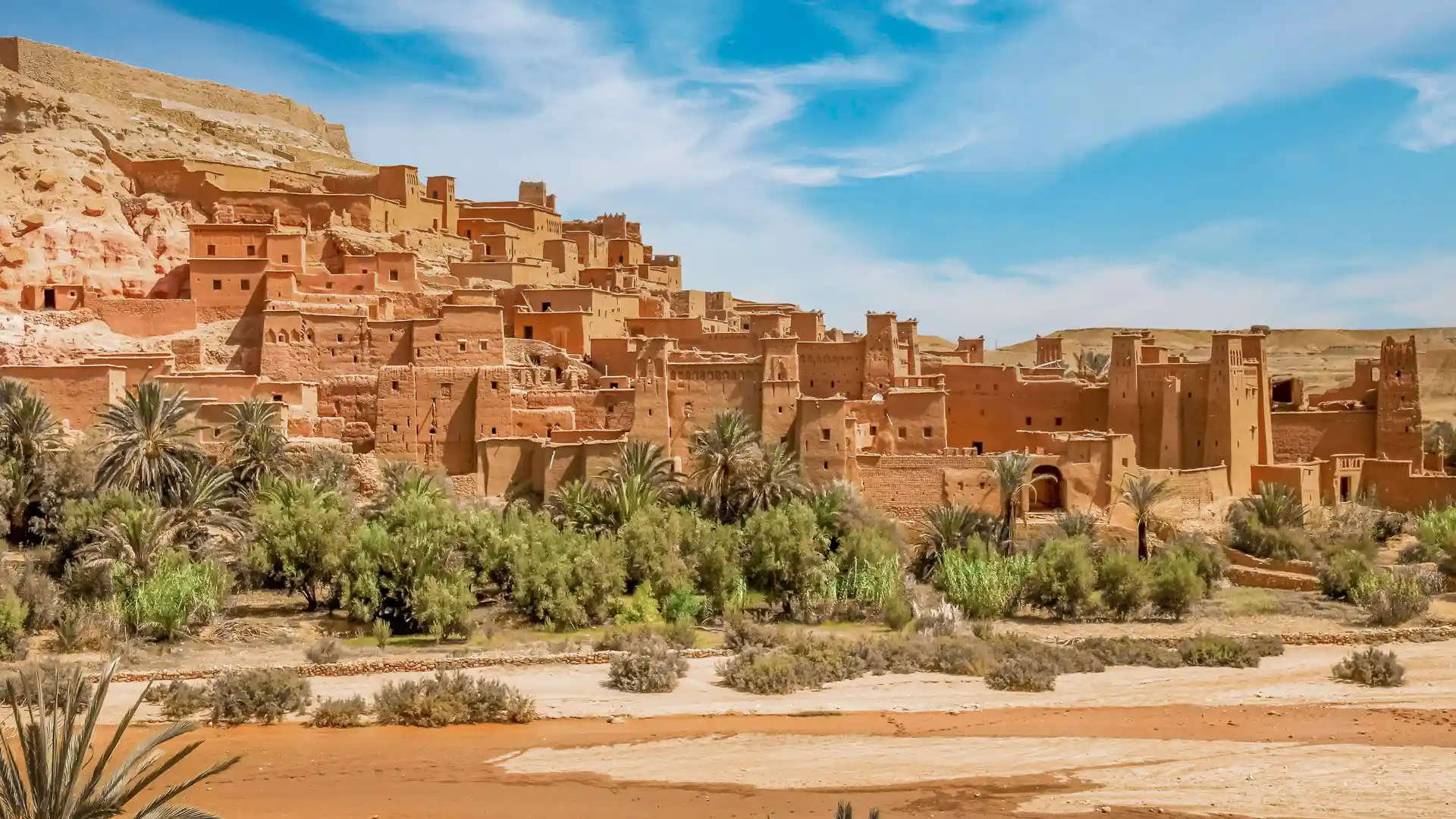
Most travelers spend 45 minutes at Ait Ben Haddou, snap a photo from the parking lot, and leave thinking they have seen it. They have not. What they missed: six separate kasbahs, nearly 50 individual houses, the defensive architecture that convinced UNESCO to list it in 1987, and the specific corners that appeared in Gladiator, Game of Thrones, and The Mummy. This guide tells you what you are actually looking at when you stand across the Ounila River from those earthen towers, how to time your visit to avoid the 10 AM tour bus rush, and whether this stop is genuinely worth the detour on the drive from Marrakech to the Sahara.
Quick Facts
- Location: 30 km northwest of Ouarzazate, 180 km from Marrakech via Tizi n’Tichka
- UNESCO status: Listed in 1987 under criteria IV for outstanding earthen architecture
- Age: Founded around the 11th century; current buildings mostly 17th century, reconstructed after 1960 earthquake
- Number of kasbahs: 6 major kasbahs, nearly 50 individual houses
- Residents: Only about 8 families live inside year‑round; most moved to the modern village across the river in the 1960s
- Entrance fee: 10 MAD (about $1 USD) per person, collected at the main gate
- Parking: Free in a guarded lot; tip of 5–10 MAD appreciated
- Opening hours: Sunrise to sunset; gatekeepers often leave by 6 PM
- Visit time: 1–2 hours for a casual walk, add 1 hour for the ridge or opposite bank viewpoint
- Best photo light: Golden hour – sunrise or 1 hour before sunset; the mudbrick glows orange
- Classic film shot: From the dry riverbed, 100 metres west of the main gate, replicating the Gladiator approach
- Films shot here: Lawrence of Arabia, Gladiator, Game of Thrones, The Mummy, Aladdin, and more
- Toilets: One WC near entrance (5 MAD); café toilets available with a drink (mint tea 10–15 MAD)
- Guide offers: Unofficial guides at parking lot charge 50–100 MAD; licensed guides via tour agency provide deeper context
All prices in Moroccan Dirham (MAD) and approximate USD equivalents where applicable.
Why Ait Ben Haddou Became a UNESCO Ksar
UNESCO listed Ait Ben Haddou as a World Heritage Site in 1987 under criteria IV: an outstanding example of earthen architecture. The ksar contains six kasbahs and nearly 50 individual houses packed inside fortified walls, all built using rammed earth and mud brick. Founded around the 11th century by the Ait Ben Haddou tribe, an Amazigh clan, it sits on the old caravan route between the Sahara and Marrakech. Its position made it a critical trading post for salt, gold, and goods moving north across the Atlas Mountains.
The architecture is not random. Narrow alleyways slow invaders, high walls block desert winds, and the central agadir (fortified granary) stores grain for the entire community during sieges. The main gate faces west to catch the cooling evening breeze and to align with the setting sun, which provides passive heating in winter when temperatures drop to 5°C at night. The towers are positioned to give overlapping fields of coverage across the riverbed below.
Most guides gloss over the Amazigh communal ownership system that built this place. Families owned individual houses, but the outer walls, gates, and granary belonged to everyone. Maintenance was collective: every household contributed labor or materials to repair storm damage. Today only about eight families still live inside the ksar year-round. The rest moved to the modern village across the river in the 1960s when roads made the defensive position unnecessary. The ksar you walk through today is a reconstruction of this system, not a living community, which is the first thing most articles get wrong.
Ait Ben Haddou Film History: More Than Gladiator
Over 20 major films and television series have used Ait Ben Haddou since 1962. Directors return because the ksar can represent ancient Mesopotamia, biblical Egypt, medieval North Africa, or a fantasy city with minimal set dressing. Lawrence of Arabia (1962) was the first major production to film here. Gladiator (2000) used it as the gates of Rome and for the city of Germania in the opening battle sequence. Game of Thrones Season 3 used the grain silo tower as Yunkai, the slaver city. The Mummy (1999) filmed opening scenes here as ancient Thebes. More recently, Aladdin (2019) used it for street market scenes.
The most photographed angle for film scenes is from the dry riverbed looking up at the central ridge. Stand about 100 metres west of the main gate to replicate the Gladiator approach shot. The crew built temporary wooden gates here during filming; they were dismantled after wrapping, but you can still see the mounting holes in the mudbrick. Do not expect permanent props or sets. Film crews dismantle everything within days. What you see is the original ksar plus decades of repair work funded by tourism and UNESCO grants.
How to Get to Ait Ben Haddou from Ouarzazate or Marrakech
Ait Ben Haddou sits 30 kilometres northwest of Ouarzazate along the N9 highway. The drive takes 30 to 40 minutes in good weather. The first 28 kilometres are paved and well-maintained. The final two kilometres are graded gravel, passable in any car during dry months but occasionally washed out by flash floods between October and March. Leave Ouarzazate by 8:30 AM during peak season (March through May and September through October) to beat the tour buses. The parking lot fills by 9:30 AM.
Taxis from Ouarzazate charge 150 to 200 MAD ($15 to $20 USD) one way. Negotiate the return trip in advance; taxis rarely wait more than an hour without charging extra. From Marrakech, the ksar is 180 kilometres away, roughly three and a half hours via the Tizi n’Tichka pass. Most travelers combine it with Ouarzazate as a full-day excursion or as a stop on the first day of a desert tour. For the full picture of distances and timing on the Marrakech to Sahara route, our guide to Marrakech to Sahara distance and travel time covers every leg of that journey.
Parking is free in a guarded lot about 100 metres from the ksar entrance. The attendant expects a small tip of 5 to 10 MAD when you return. In summer, the riverbed crossing is dry and you walk straight across. After rain, a local with a donkey may offer to carry your bag across a shallow stream for 10 MAD. The “you will need a guide” pitch starts the moment you step out of the car. You do not need one. The main street is open and obvious.
What to Expect Inside the Ksar: Practical Visit Tips
Entrance costs 10 MAD (about $1 USD) per person as of 2025. A local caretaker collects the fee at the main gate; there is no official ticket booth. Opening hours run from sunrise to sunset, though gatekeepers usually leave by 6 PM. You can walk the main street and explore the lower courtyards freely. The upper kasbahs may be locked or require a small tip of 10 to 20 MAD to a guardian who holds the keys.
Total visit time ranges from one to two hours for a casual walk to the grain silo tower. Add another hour if you hike to the ridge or cross the river to shoot from the opposite bank. Wear good walking shoes, the cobblestone paths are uneven and the upper levels involve steep climbs with loose gravel. There is no shade inside the ksar. Summer temperatures reach 40°C by midday. Bring a hat and sunscreen and carry water. One official WC near the entrance charges 5 MAD. Café toilets are available if you buy a drink; mint tea is 10 to 15 MAD.
Souvenir shops line the main street. Bargaining is expected; start at 30% of the asking price. Local unofficial guides will approach you in the parking lot offering tours for 50 to 100 MAD. Save your money for a licensed guide through a tour agency if you want serious historical context. The best view of the entire ksar is from the hill on the opposite bank of the Ounila River. Walk across the dry riverbed and climb the rocky slope for the classic perspective without crowds in the frame.
Is Ait Ben Haddou Worth It on the Marrakech to Sahara Route?
Ait Ben Haddou appears on nearly every Sahara desert tour itinerary as a two-hour stop on Day 1. It is worth it for history and film fans. Travelers short on time and prioritizing landscape stops like the Todra Gorge or the dunes of Erg Chebbi can reasonably skip it. Alternative stops along the same road include Kasbah Taourirt in Ouarzazate, which has a more intact interior, and the Skoura palm oasis, which sees far fewer tourists.
Crowd levels peak between 10 AM and 2 PM during high season. Photography is best at golden hour: just after sunrise or one hour before sunset, when the mudbrick glows orange and shadows sharpen the architectural detail. If you arrive at midday and want to avoid the crowds, take photos from the riverbed and move on. The silhouette from the opposite bank is still strong, and you will save time for a less-visited stop further down the valley.
What Other Bloggers Get Wrong About Ait Ben Haddou
Most travel articles describe Ait Ben Haddou as a “living village” or “ancient settlement where people still live.” That is misleading. Only about eight families reside inside the ksar year-round, almost all running guesthouses or souvenir shops. The rest of the original population moved to the modern village across the river in the 1960s. The ksar is a tourist attraction that happens to have a UNESCO designation. It is not a functioning community.
A second common myth: that the structures are thousands of years old. The current buildings date mostly to the 17th century, with extensive 20th-century reconstruction after the 1960 earthquake. The site has been occupied since the 11th century, but the buildings you see are not original. They are faithful reconstructions using traditional pisé (rammed earth) techniques. This does not reduce their value. It just clarifies what you are standing in. The architecture is authentic. The occupation is largely commercial. Knowing this before you arrive means you look at the place correctly rather than feeling vaguely disappointed when a souvenir seller walks past a 400-year-old gate.
Ready to Explore More of the Desert Route?
Ait Ben Haddou is more than a film set. It is a specific window into centuries of Amazigh architecture and caravan-era construction. Plan your stop carefully: arrive early or stay late, skip the unofficial guides, and walk across the river for the clean shot. The mudbrick walls and defensive towers show how communities survived in the pre-road desert in ways that the modern village across the river has completely erased.
The next stops on the Marrakech to Sahara route typically include the Dades Gorge, the Draa Valley, and eventually the dunes at Merzouga. If you are still planning how many days to allocate to this stretch, our guide on how many days to spend on a Sahara desert tour gives honest recommendations for every starting point and budget. For the full route from Marrakech, our post on how to plan a Sahara desert tour from Marrakech covers every decision you need to make before you leave the city.
Ait Ben Haddou sits on the route of several of our most popular private desert tours. Our 3-day Marrakech desert tour passes through it on Day 1 with enough time to arrive early and avoid the buses. Our Fes to Marrakech desert tour crosses the same route from the other direction, combining the ksar with the Dades Valley and Erg Chebbi. For those wanting the full picture of Morocco, our 10-day Morocco Sahara desert tour builds Ait Ben Haddou into a properly timed itinerary that does not rush any stop. Every tour is private. You set the pace. We handle the timing, the local knowledge, and the logistics.
📩 Contact us: contact@mementomorocco.com | +49 1522 3075977 | WhatsApp