Sahara Desert Weather: Your Month-by-Month Planner
Most people get the Sahara weather wrong. Yes, it is brutally hot. But that is only half the story. In a single day, you can go from 46°C (115°F) heat to near-freezing cold at night if you are not prepared. So when is the best time to visit the Sahara? What does it actually feel like, month by month? This guide gives you real temperatures, sandstorm timing, what nights feel like in each season, and what to pack so you don’t get it wrong.
Sahara Desert Weather at a Glance: Month-by-Month Reference
Before the detail, here is the full picture. This table is based on conditions at Erg Chebbi near Merzouga, the most visited desert area in Morocco. Zagora sits slightly lower in elevation and runs two to three degrees warmer at night across all seasons. If you just want the answer, this is the best time to visit the Sahara, month by month:
| Month | Day Temp | Night Temp | Sandstorm Risk | Verdict |
|---|---|---|---|---|
| January | 18–22°C (64–72°F) | 0–5°C (32–41°F) | Very low | Good — pack warm layers |
| February | 20–25°C (68–77°F) | 3–8°C (37–46°F) | Very low | Good — nights still sharp |
| March | 24–30°C (75–86°F) | 8–14°C (46–57°F) | Low–moderate | Excellent |
| April | 28–35°C (82–95°F) | 12–18°C (54–64°F) | Moderate | Very good |
| May | 32–38°C (90–100°F) | 16–20°C (61–68°F) | Moderate–high | Good — heat rising |
| June | 34–42°C (93–107,4°F) | 20–24°C (68–75°F) | Low | Strategy required |
| July | 35–44°C (95–111°F) | 22–26°C (72–79°F) | Low | Hard — committed travelers only |
| August | 35–46°C (95–115°F) | 22–26°C (72–79°F) | Low | Hardest month |
| September | 34–40°C (93–104°F) | 18–22°C (64–72°F) | Low–moderate | Good — heat easing |
| October | 28–34°C (82–93°F) | 12–18°C (54–64°F) | Moderate | Very good |
| November | 22–28°C (72–82°F) | 6–12°C (43–54°F) | Very low | Excellent |
| December | 18–23°C (64–73°F) | 0–6°C (32–43°F) | Very low | Good — pack very warm |
Data collected from timeanddate.com
The Three Real Seasons of Sahara Desert Weather
The Sahara runs on three climatic phases, not four traditional seasons. During the shoulder months (March through May, September through November), daytime temperatures range from 25°C to 35°C (77°F to 95°F), while nights cool to 10°C to 20°C (50°F to 68°F). This is the window most experienced travelers choose: you can hike, ride camels, and sleep comfortably without extreme gear or extreme strategy.
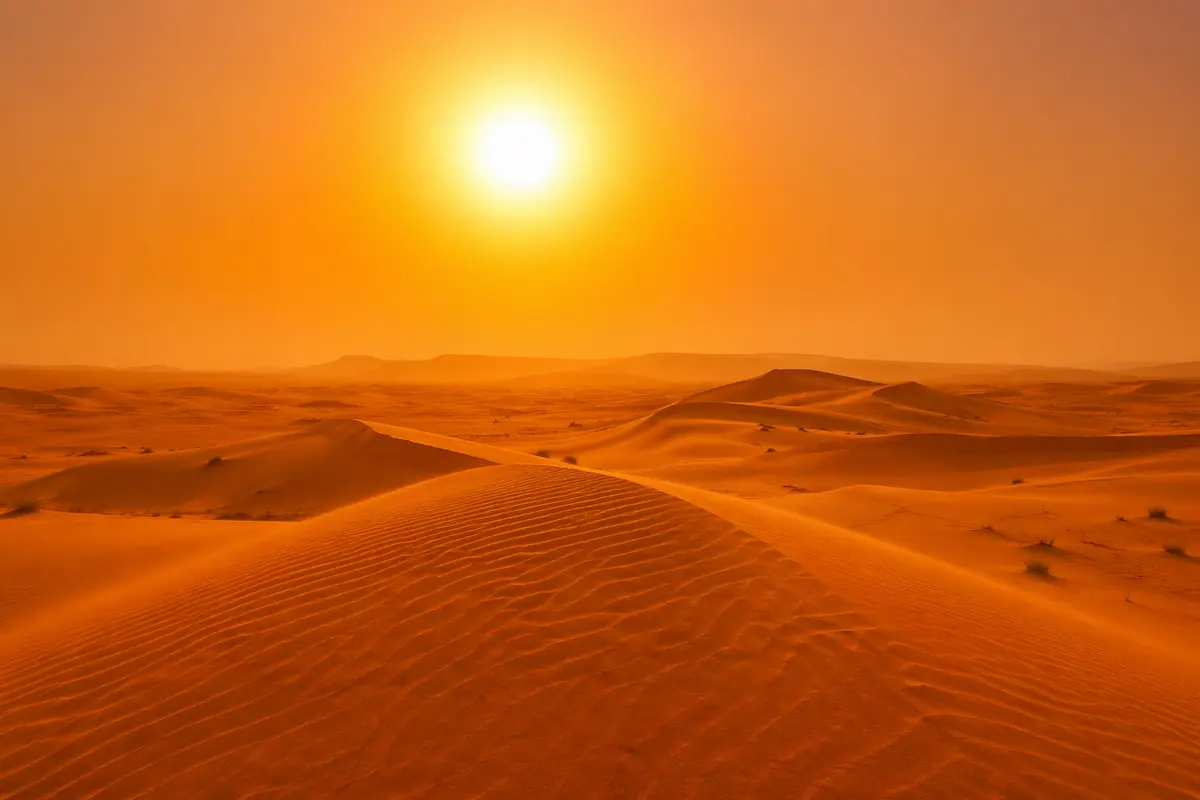
Peak summer (June through August) brings daytime temperatures of 38°C to 46°C (100°F to 122°F) in the shade, with nights staying warm at 20°C to 26°C (68°F to 79°F). The heat is intense and completely still, pressing down like a physical weight that does not lift until well after sunset. Winter (December through February) reverses everything: days are pleasant at 18°C to 25°C (64°F to 77°F), but nights plunge to 0°C to 10°C (32°F to 50°F), sometimes dipping below freezing before dawn.
Erg Chebbi near Merzouga sits at roughly 700 metres elevation and experiences slightly milder extremes than the deeper, more arid stretches near Zagora. The altitude explains the rapid temperature drop after sunset: heat escapes quickly into the thin, dry air, and there is no coastal humidity to slow the cooling. This is why you need real layers even in April, and why your sleeping bag’s comfort rating becomes a practical safety issue in winter. For the broader seasonal picture across all of Morocco, not just the desert, our month-by-month Morocco travel guide covers what each period means for every region.
What Most Guides Get Wrong About Winter in the Sahara
The standard advice is “winter is mild and perfect for visiting.” That is only half true. Days are genuinely comfortable, but the cold at night is a dry, penetrating cold that standard sleeping bags often cannot handle. Luxury desert camps provide heavy blankets and sometimes heated tents, but mid-range camps may only offer thin bedding. Always ask specifically about nighttime bedding when booking for December through February. Our guide to desert camp facilities breaks down what each tier actually provides so you can compare before you commit.
The temperature gap between 3 PM and 3 AM can exceed 20°C (36°F). Most travelers pack for the pleasant day and suffer through the night. If you are specifically planning a winter trip, our dedicated post on visiting the desert in winter covers exactly what to bring and what to expect hour by hour.
Sahara Night Temperatures: Hour by Hour Reality
Summer nights (June through August) in Merzouga rarely drop below 20°C (68°F). You sleep under a sheet, possibly kicking it off by midnight. The sand beneath your tent radiates stored heat until well past midnight. You will not need a sleeping bag at all during these months, and stargazing from your tent entrance is entirely comfortable in shorts and a light layer.
Winter nights (December through February) are a different world. Temperatures plummet after sunset. By 10 PM you are at 10°C (50°F). By 2 AM, expect 3°C to 8°C (37°F to 46°F). Pre-dawn, around 5 AM before the sun breaks, temperatures can hit 0°C (32°F). Frost on the sand is not common, but it happens. The metal zipper on your tent will feel like ice when you touch it. Your water bottle, left outside, will be painful to hold.
Shoulder month nights offer the sweet spot: 12°C to 18°C (54°F to 64°F), comfortable for hours of stargazing. Wind is the hidden variable that temperature charts never capture. A light breeze on a 15°C night can feel like 5°C because there is zero humidity to hold warmth against your skin.
Practical tip: Place your closed-toe shoes inside your tent every night without exception. Scorpions shelter in warm footwear, and waking up to find one inside your boot is a genuinely avoidable situation. This applies in all seasons, not just summer. Your shoes will also be stiff and painfully cold in winter if left outside overnight.
Morocco Sandstorm Season: Myths and Real Preparedness
The Morocco sandstorm season runs primarily from late March through May, with a secondary, less predictable period in October. These storms are driven by the Chergui wind, a hot dry easterly that picks up fine particles and carries them across the dunes. Your actual chance of encountering one during peak season is 10% to 20%, not a daily certainty.
A Sahara sandstorm is not the apocalyptic wall of sand you see in films. It is a thick orange-brown haze that reduces visibility to 50 to 100 metres and deposits fine dust everywhere: in your hair, your bag, the threads of your camera lens. Typical duration is two to four hours, not days. Storms often arrive in the afternoon as temperatures peak and wind patterns shift. By evening the air usually clears completely.
Preparedness beats fear. Carry a lightweight shemagh (desert scarf) to wrap around your face, neck, and over your phone or camera. These cost 50 to 100 MAD ($5 to $10) in any Marrakech souk; buy one before you leave the city. Ziploc bags protect electronics from fine dust, which infiltrates ports and lenses far more effectively than visible grains. When finalising your desert kit, our complete Sahara packing list covers sandstorm gear alongside everything else you will actually need.
How Local Guides Handle Sandstorms
Experienced guides monitor the Chergui forecasts daily. If a wind event is predicted, they adjust your schedule: an earlier camel trek at 4 PM instead of 6 PM, or a longer rest inside the camp’s communal tent through the worst hours. This is not excessive caution; it is logistics. You still experience the desert fully, just with timing that avoids the worst visibility and dust inhalation. A good guide reads the desert. That is the difference between improvising in difficult conditions and moving through them cleanly.
Visiting the Sahara in Summer: The Strategy That Works
August in the Sahara is the hardest month. Peak heat between 11 AM and 5 PM regularly exceeds 46°C (115°F) in direct sun. Moving feels like pushing through a physical barrier. But summer is not impossible if you approach it correctly. Our full guide on visiting the Sahara in summer covers the complete day-by-day approach. The short version is this:
Stay in air-conditioned lodging until 5 PM. At 5:30 PM, as temperatures drop toward 42°C (107°F), begin a camel trek of 60 to 90 minutes toward your desert camp. Arrive at sunset around 7:30 PM, when the air has cooled to 35°C (95°F). Eat dinner outdoors as it cools further. Sleep early. Wake at 5 AM for a sunrise trek, when the air is 25°C (77°F) and the dune light is clean and gold. That is your active window: early evening and early morning. Everything between 11 AM and 5 PM is rest.
Hydration is the difference between a memorable experience and a dangerous one. Aim for four to five litres of water per person per day. Electrolyte sachets (20 MAD / $2 at any Moroccan pharmacy) are not optional in summer; water alone will not replace what you lose. Luxury camps often have small plunge pools for a mid-afternoon cool-down. Use them. The psychological relief of cold water in 45°C heat is as valuable as the physical effect.
Choosing the Right Season for Your Travel Style
The best season for the Sahara is not universal. It depends entirely on what you want from the experience and what you are willing to manage.
- March, April, October, November: The four best months overall. Comfortable days, cool nights, low sandstorm risk. These windows fill fastest. If your dates are flexible, choose here first.
- December, January, February: Beautiful clear days, genuinely cold nights. Right for travelers who want silence, smaller crowds, and are prepared to layer heavily after sunset. Read our winter desert guide before booking.
- May, September: Transition months. May gets hot fast; September is still warm but easing. Both are workable with the right camp and schedule.
- June, July, August: For travelers who cannot travel at any other time. Follow the summer strategy above. Choose a camp with a plunge pool. Accept that 80% of your experience happens outside the hours of 10 AM to 5 PM.
For a broader picture of how the desert conditions sit within a full Morocco itinerary, our complete guide to Sahara desert tours covers route options, how many days to allocate, and what different price points actually deliver. If you are still deciding how long to spend in the desert specifically, our post on how many days you need for a Sahara tour gives honest recommendations by season and travel style.
The Sahara Does Not Reward Improvisation
Every hour of the day in the Moroccan desert has a right and a wrong way to use it. The travelers who leave satisfied are the ones who planned around the desert’s rhythm, not against it. They arrived in the right season, packed for both the daytime heat and the nighttime cold, and traveled with guides who knew how to read the conditions rather than just follow a fixed schedule.
The shoulder months (March through May and September through November) fill up faster than any other period. If your dates fall in this window, it is worth locking in your itinerary earlier rather than later. The right camp in the right season with the right guide makes everything else easier.
We design private Sahara tours built around the seasonal conditions described in this guide. Every itinerary is timed around the best daily windows, the right camp for the right season, and guides who have worked in these conditions for years. Our 3-day Marrakech desert tour and 3-day Fes desert tour are the most direct routes into Merzouga. For a fuller experience of Morocco alongside the desert, our 10-day Morocco Sahara tour combines Erg Chebbi with Fes, the Atlas Mountains, and Chefchaouen. Tell us your season and we will match the route to the conditions.
📩 Contact us: contact@mementomorocco.com | +49 1522 3075977 | WhatsApp