How many days for Sahara Desert Tour: Is 2, 3, or 4 Days Best?
You round the final hairpin on the Tizi n’Tichka pass, and the mountains vanish. Ahead, a flat, russet plain stretches toward an orange haze that might be heat shimmer or the Sahara itself. Your driver shrugs when you ask how far. “Depends which Sahara you mean.” This is the moment most travelers realize the decision they made weeks ago, booking a tour based on price and catchy marketing, will define the next 48 to 96 hours of their trip. The truth is, the ideal number of days for your Sahara desert tour depends less on the brochure promises and more on your starting point, stamina, and what you truly want to experience beyond a sunset camel ride. By the end of this guide, you’ll understand not just the itineraries, but the feel, pace, and hidden trade-offs of each option, so you can book with confidence.
The Core Factor: Your Starting City & The Sahara’s Gates
The biggest mistake travelers make is treating all Sahara tours as equal. They are not. The single most important factor determining your viable tour length is the distance between your departure city and the desert gateways of Merzouga (Erg Chebbi) or Zagora (Erg Chigaga). From Marrakech to Merzouga, you face 550 km and 9 to 10 hours of driving via the winding Tizi n’Tichka pass, a mountain road that climbs to 2,260 meters before descending into the Ouarzazate basin. From Fes, the journey is shorter at 470 km and 7 to 8 hours, cutting through the Middle Atlas via Midelt and the dramatic Ziz Valley.
Departing from Tangier adds another layer of complexity: you are looking at 10+ hours of continuous driving just to reach the desert edge, making a 2-day tour physically punishing and frankly irresponsible. You can read our blog article to learn more about the route guide between Tangier and the Sahara Desert. Meanwhile, the route from Marrakech to Zagora (gateway to Erg Chigaga) is only 360 km and 6 to 7 hours, but Chigaga itself is more remote, requiring an additional 4×4 transfer across trackless desert that standard vehicles cannot handle. This is not a simple choice between tour companies. It is a geographic calculation.
Most tours target Merzouga because Erg Chebbi delivers the postcard dunes: towering, ridged, and over 150 meters tall in places. Zagora’s Erg Chigaga is wilder, less developed, and accessed only by experienced drivers navigating dry riverbeds and stone plains. If you see a tour promising “the real Sahara” from Marrakech in 2 days, check which erg they mean. The real journey to Chigaga demands time, and trying to rush it turns the experience into a dusty ordeal rather than an adventure. Understanding the actual distances and road conditions between Marrakech and the Sahara is the foundation of choosing your tour length wisely.
The 2-Day Sahara Desert Tour: A Whirlwind Reality Check
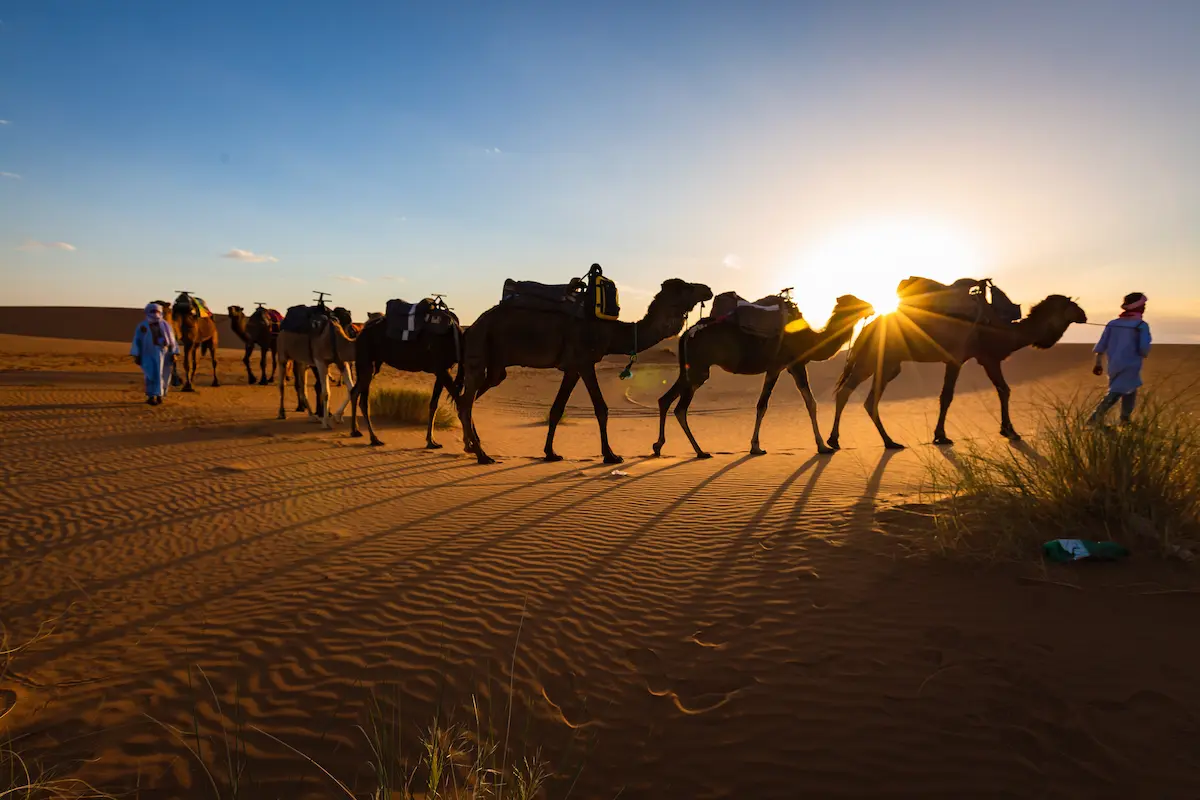
Let me be blunt: a 2-day Sahara tour is not a cultural immersion. It is a marathon transit punctuated by a single memorable night. If you book a standard Marrakech to Merzouga 2-day tour, here is what actually happens. Day 1: you leave Marrakech at 7 AM, drive 10 hours with brief photo stops at Ait Benhaddou and perhaps Ouarzazate, and arrive at your desert camp near dusk, exhausted. Day 2: you wake at 5 AM for a sunrise camel ride, eat breakfast, and immediately begin the 10-hour return drive to Marrakech, arriving back in Marrakech in the dark.
The price reflects this stripped-down schedule: expect to pay 1,800 to 2,800 MAD ($180 to $280 USD) per person for a standard group tour, sometimes less if booked through aggressive resellers in the Marrakech medina. Who is this for? Travelers with extreme time constraints who prioritize ticking “slept in the Sahara” off their list over actually experiencing the journey. You will miss the Draa Valley’s ancient kasbahs, the towering walls of Todra Gorge, and any meaningful interaction with Amazigh communities along the route. You sleep in the desert, yes, but you experience little of what makes the southern Morocco journey transformative.
The physical toll is real. If you arrive in Morocco jetlagged, a 2-day tour will compound your fatigue. The drives are long, the roads after Ouarzazate become rougher, and sitting in a van for 20 hours across two days while trying to absorb new sights is harder than most anticipate. The camp experience itself can be excellent, especially if you upgrade to a luxury desert camp with private tents and real beds, but you will have perhaps 4 waking hours to enjoy it before the return sprint begins. If time is your absolute constraint and you are departing from Marrakech, this option exists, but understand what you are sacrificing.
The 3-Day Desert Tour: The Balanced Sweet Spot
This is the minimum duration we recommend for anyone seeking a balanced experience from Marrakech or Fes, and it is the most popular choice for good reason. A standard 3-day Marrakech to Merzouga route unfolds like this: Day 1, you drive via Ait Benhaddou and Ouarzazate, stopping for lunch and photos, and spend the night in a hotel or traditional kasbah in the Dades Valley or near Todra Gorge. Day 2, you explore Todra Gorge in the morning, its 300-meter-high limestone cliffs narrowing to a slot canyon just wide enough for a single vehicle, then continue to Merzouga for a late afternoon camel trek and your desert camp night. Day 3, after sunrise and breakfast, you return to Marrakech via the Draa Valley, arriving by evening.
From Fes, the route shifts: you pass through Ifrane (the “Switzerland of Morocco” with cedar forests), the Amazigh town of Midelt, and descend through the Ziz Valley gorges, stopping at fossil workshops in Erfoud where you can see ammonites and trilobites extracted from the surrounding rock strata. The desert night remains the centerpiece, but the journey there and back offers varied landscapes and cultural stops rather than relentless asphalt. Standard group tours cost 2,500 to 4,000 MAD ($250 to $400 USD) per person. Private tours start around 5,000 MAD ($500+ USD) and scale with group size and accommodation quality.
The key difference from the 2-day version is pacing. You have two scenic driving days with intentional stops, a full evening and night in the desert to settle into the silence and stargaze without rushed anxiety, and a more relaxed return. You will still spend significant hours in the vehicle, but it does not feel punishing. Let me walk you through a typical Day 2 hour-by-hour. You leave your Dades or Todra accommodation around 8 AM, reach Todra Gorge by 9 AM, and have an hour to walk its cool, shadowed floor. By 11 AM, you are driving through Tinjdad and the Tafilalet oasis, stopping for lunch in Erfoud or Rissani around 1 PM. You arrive in Merzouga by 4 PM, transfer to camels by 5 PM, and trek 90 minutes into Erg Chebbi, reaching camp by 6:30 PM as the light turns gold. This is the classic Sahara tour structure that delivers iconic moments without brutal fatigue.
The 4-Day (or More) Tour: Immersion & Alternative Routes
If the 3-day tour is the efficient highlight reel, the 4-day (or longer) tour is where Morocco stops being a destination and becomes a place you inhabit, even briefly. This is the duration for travelers, not tourists. The extra day or two allows detours, deeper cultural engagement, and exploration of secondary sites that shorter tours bypass entirely. A 4-day tour from Marrakech might include a full morning hike into Todra Gorge, a visit to the Khamlia village near Merzouga (home to Gnawa musicians descended from sub-Saharan traders), or a second night in the desert itself, giving you time to explore the dunes on foot at dawn.
But the premier 4 to 5-day option is the Fes to Marrakech desert crossing, or the reverse. This route eliminates backtracking entirely. You traverse both the Middle Atlas and the High Atlas, spend a night in the desert, and end in a different imperial city, maximizing your Morocco itinerary efficiency. Along the way, you can include the Valley of Roses near Kalaat M’Gouna (harvest in April and May), the ancient ksour (fortified villages) of the Draa Valley, and even a detour to the remote Erg Chigaga dunes if you choose a private tour with 4×4 capability. Prices rise significantly, especially for private tours, but the cost per meaningful experience hour actually improves.
Let me give you a specific example of what longer time unlocks. In Khamlia, a village 7 km from Merzouga, you can attend a live Gnawa music performance in a family home, not a staged tourist venue. Gnawa music, with its hypnotic guembri bass lute and metal castanets, traces its roots to spiritual brotherhoods and West African rhythms brought by enslaved people centuries ago. The performance is participatory, the tea is real, and the conversation afterward, often in French or broken English, reveals how tourism and tradition coexist in these small communities. This takes 90 minutes. A 2-day tour has no room for it. A 3-day tour might squeeze it in if the group agrees. A 4-day tour can include it without stress. That is the qualitative shift longer durations provide. You can explore the detailed Fes to the Desert route here, which showcases how an extra day or two transforms a journey into a crossing.
Beyond Days: Seasonal, Style & Tour Type Decisions
The “best” tour length is not fixed. It shifts with the season, your comfort threshold, and whether you choose a group or private tour. Summer (June to August) changes the calculus entirely. Daytime temperatures in the desert and the pre-desert plains regularly exceed 40°C (104°F), and spending 8+ hours in a vehicle, even with air conditioning, becomes a test of endurance. A 4-day tour in summer allows you to drive during cooler morning and evening windows, take a long midday break in a shaded kasbah, and avoid the punishing afternoon heat on the road. A 2-day summer tour, by contrast, often means driving straight through the hottest hours because there is no time to wait.
Winter (December to February) flips the concern. The drives are more pleasant, but desert nights at the camps can drop to 0°C (32°F) or slightly below. Most camps provide heavy blankets, but if you are in a standard tent with thin walls, you will feel the cold. If you are doing a winter tour, pack thermal layers, a warm hat, and consider upgrading to a luxury camp where the tents have thicker insulation and proper heating. The shorter winter days also mean you will do some driving in the dark, which reduces the scenic payoff on the return leg of a 3-day tour.
Tour type matters as much as duration. A private 3-day tour can cover more ground and offer more flexibility than a group 4-day tour because you control the stops, the pace, and the departure time. Group tours operate on fixed schedules, often leaving at 7 AM sharp and adhering to predetermined photo stop durations. If you want to linger at a viewpoint, photograph the changing light on the Dades Valley rock formations, or skip a lunch stop to reach the dunes earlier, a group tour will not accommodate you. Private tours cost more upfront but eliminate those frustrations. And if you are investing 400+ USD per person on a luxury desert camp with fine dining and spa-style tents, pairing it with a rushed 2-day tour is poor value. You want time to enjoy what you paid for, not just sleep there and leave. Understanding the seasonal nuances of Morocco travel helps you match tour length to comfort and safety.
What Most Guides Get Wrong About Sahara Tour Duration
Here is the contrarian truth: most travel blogs and tour companies tell you a 2-day tour is “perfect for travelers short on time.” That is not advice. That is marketing. What they should say is this: if you have only 2 days to allocate to the desert, you should reconsider whether a Sahara tour fits your trip at all, or you should adjust your Morocco itinerary to create more time. The Sahara is not a theme park attraction you tick off in 48 hours. It is a place where silence, scale, and light create an experience that requires time to absorb.
Another myth: “all 3-day tours are the same.” They are not. The Marrakech route emphasizes High Atlas mountain scenery and film studio history in Ouarzazate. The Fes route emphasizes Middle Atlas forests and geological drama in the Ziz Valley. Neither is better. They are different. If your Morocco trip already includes Marrakech but not Fes, or vice versa, that should guide your departure city choice, not just price. And finally, tour companies rarely clarify this: on a “3-day tour,” you sleep one night in the desert. The other night is in a valley hotel. On some 4-day tours, you get two desert nights. On others, you still get one desert night plus extra time in kasbahs or exploring side routes. Always read the itinerary breakdown, and if it is vague, ask specific questions before booking.
So, What’s the Verdict on Your Sahara Tour Length?
Choose 2 days only if time is your absolute, non-negotiable constraint and you are departing from Marrakech or Fes. Understand it is a transfer with a memorable night, not a journey. For 95% of travelers, the 3-day tour from Marrakech or Fes is the balanced minimum, delivering the iconic highlights and desert night efficiently without collapsing into exhaustion. If you seek a transformative journey, not just a visit, have the budget, and especially if you can travel from Fes to Marrakech (or vice versa), invest in 4 days or more.
Your ideal duration is the first major decision, but it is just the start of crafting a perfect Sahara experience. The next layer is choosing your camp quality, deciding between group and private, and understanding what seasonal factors (heat, cold, Ramadan timing) will affect your specific travel dates.
We have designed Sahara tours for travelers starting from Marrakech, Fes, and Tangier for over a decade. We know which routes feel rushed in July, which camps offer the best stargazing in January, and how to structure a 4-day itinerary that includes the dunes, the valleys, and the cultural stops most tours skip. Whether you have 2 days or 5, let our local experts design a private Sahara tour from your starting point that matches your pace, interests, and travel style. Get a customized itinerary.
📩 Contact us: contact@mementomorocco.com | +49 1522 3075977