Sahara Desert Packing List: The Complete Guide
Imagine standing atop a sea of gold at Erg Chebbi, the sun dipping below the horizon, and realizing your thin cotton shirt won’t cut the coming chill of a desert night. That’s the moment generic packing lists fail you. This is your definitive Sahara desert packing list, crafted from guiding thousands of travelers through the dunes. You’ll get a season-specific, culturally-informed checklist that covers exactly what to wear in the Sahara desert, what to leave behind, and crucial logistical tips most blogs ignore. Pack right, and you focus on the experience, not the discomfort.
What to Wear in the Sahara Desert: Fabric, Fit & Culture
Clothing choices in the Sahara are a trifecta: personal comfort, cultural respect, and practical adaptation to extreme environments. Merino wool or technical synthetics win for base layers because they wick sweat, dry fast, and resist odor after days without laundry. Cotton absorbs moisture and holds it, leaving you clammy at night when temperatures plummet to 5°C (41°F) in winter months like December and January.
Loose, light-colored, long-sleeved linen or cotton shirts are ideal for sun protection and modesty when traveling through rural villages like Rissani or Tinghir en route to the dunes. Avoid tight, revealing clothing, especially for women, as you pass through Amazigh communities where conservative dress is the norm out of respect, not rule. Men and women both benefit from covering shoulders and knees in public spaces outside your private camp. A lightweight, packable down jacket or fleece is non-negotiable for October through April nights, when desert camps offer no central heating and stars are so sharp you’ll forget the cold until you’re shivering.
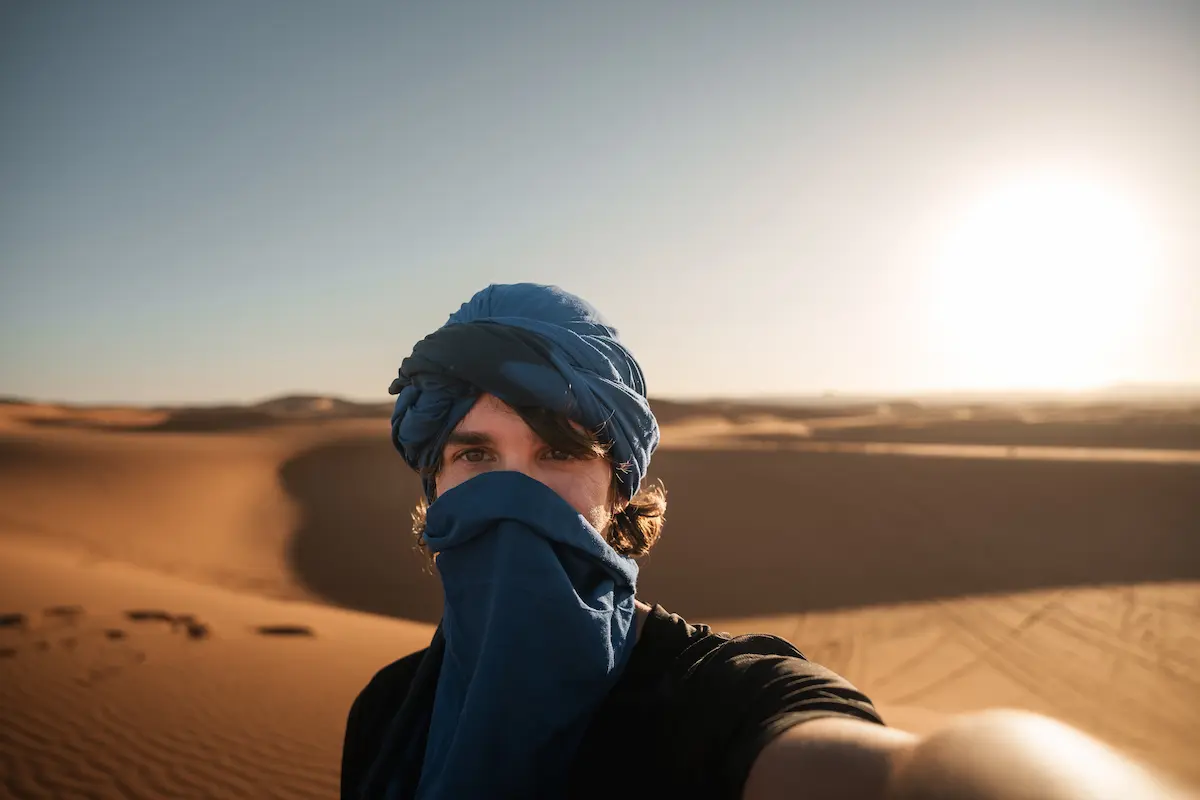
Men can buy a traditional shesh (head scarf, also called a mandil) for 50 to 100 MAD ($5 to $10 USD) in Marrakech’s Rahba Kedima square or the roadside shops in Rissani just before the dunes. Your guide will teach you to wrap it properly, covering your mouth and nose against sand during windy camel treks. Women often prefer lightweight pashminas or cotton scarves, which serve the same function and can be layered over hair for sun protection. This is one item you absolutely want to buy locally, both for authenticity and practicality.
Desert Tour Packing Tips: The Logistics Most Forget
Packing isn’t just about what’s in your bag, it’s about how you manage it during the journey from cramped 4x4s to camel treks. For camel treks or overnight desert camps, you’ll need a small overnight bag (30L backpack maximum) because your main luggage stays locked in the tour vehicle or at your hotel in Merzouga. Most travelers miss this and arrive at camp with a 70L roller suitcase, which doesn’t fit on a camel and makes guides quietly sigh.
A headlamp with red light mode is infinitely better than your phone flashlight for navigating to squat toilets at night and preserving your night vision for stargazing. Bring a portable power bank with at least 10,000mAh capacity because electricity at standard desert camps is limited to the common tent, usually running from 6 pm to 10 pm via solar or generator. Your room tent has no outlets. Pack Ziploc bags for your phone, camera, and any electronics because sand is invasive and gets into charging ports, lens mechanisms, and headphone jacks within hours of arrival.
Rehydration salts or electrolyte tablets (like Hydralyte or Nuun) are a pro move for summer tours in June, July, and August when daytime temperatures hit 40°C to 45°C (104°F to 113°F). You’ll sweat more than you realize, and plain water doesn’t replace lost salts. Wet wipes are essential because bidets are standard in Moroccan bathrooms, toilet paper often isn’t, and your desert camp’s shared facilities may run low by day two of your stay. For a detailed guide to Sahara desert tours and camp logistics, including what a typical day looks like from sunrise to campfire, see our full tour breakdown.
You can learn more about what you want to pack for a Sahara desert trip and practicale clothing tips in our blog.
Morocco Desert Clothes: What You Can Buy Locally
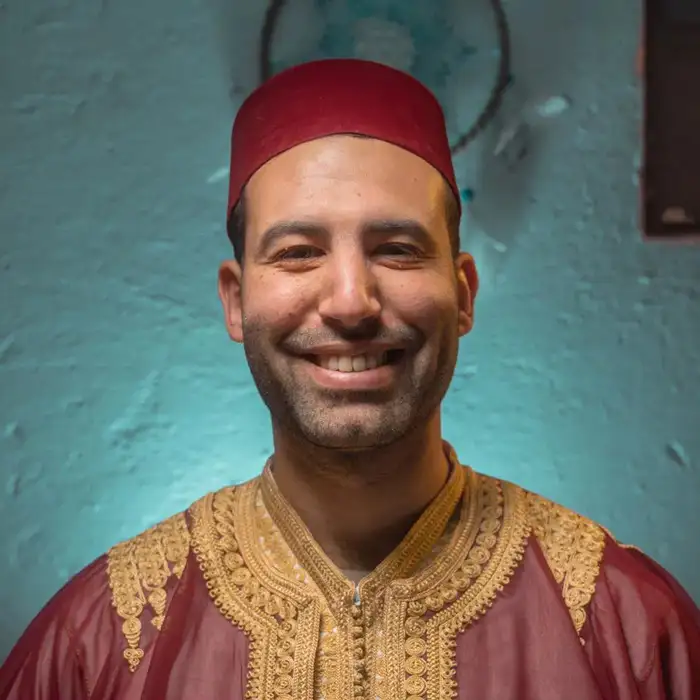
Save luggage space and support local artisans by buying certain items in Morocco rather than packing them from home. Jellabas (hooded robes) are excellent for cool evenings at camp, draping over your clothes for warmth and making you look less like a tourist in villages. They cost 150 to 400 MAD ($15 to $40 USD) in local souks, with the cheaper cotton versions fine for a few nights and the wool-blend ones worth it if you’re staying longer.
Leather babouche slippers are perfect for camp, where you’ll kick off your dusty shoes before entering tents. They cost 40 to 200 MAD ($4 to $20 USD) depending on quality and your haggling ability in Marrakech’s Jemaa el-Fna area or Fes el-Bali medina. The shesh or mandil, as mentioned earlier, is a must-buy locally and costs 50 to 100 MAD. These three items alone solve multiple packing problems and give you cultural conversation starters with your guides and camp staff.
High-factor sunscreen (SPF 50+), specialized hiking boots, and technical outdoor gear are more expensive and limited in selection once you’re in Morocco. A small tube of European sunscreen at a pharmacy in Marrakech’s Guéliz district costs 120 to 180 MAD ($12 to $18 USD) for brands you’ve never heard of, versus bringing your trusted Neutrogena or La Roche-Posay from home. A basic pharmacy (ask for “pharmacie”) in any Moroccan city can supply anti-diarrheal pills like Imodium, pain relievers, and blister plasters if you forget them, but bring prescription medications from home in their original packaging. You can explore the medinas where you can shop for these items and learn the art of respectful haggling in our medina guide.
Sahara Essentials: The Non-Negotiable Kit
Sun protection is the category where tourists fail most often. A wide-brimmed hat with a chin strap (not a floppy beach hat that flies off in desert wind) protects your face and neck during midday 4×4 stops and camel rides. UV-blocking sunglasses rated UV400 or higher are essential because sand reflects sunlight, doubling exposure and causing headaches if you squint for hours. SPF 50+ mineral sunscreen (zinc oxide or titanium dioxide formulas) lasts longer in extreme heat than chemical sunscreens, and you need to reapply every 90 minutes during summer tours. Lip balm with SPF prevents the cracked, bleeding lips that ruin your ability to enjoy camp meals by day three.
Footwear is a two-part strategy: closed-toe shoes like sneakers or light hiking shoes for walking through rocky villages, kasbahs, and the Todra Gorge stops en route to the desert, and sandals for camp. Sand gets extremely hot by midday, burning bare feet within seconds if you step outside your tent. Your sandals need back straps (not flip-flops) because loose footwear fills with sand and becomes useless during short walks to the dinner tent or toilets.
Sand management requires a buff or shesh to cover your mouth and nose during windy moments, and a small microfiber towel (40cm x 80cm) that dries fast and packs tiny for post-camel-trek refreshment. For health essentials, bring personal prescription medications, blister plasters (Compeed brand works best on camel-saddle friction points), hand sanitizer, and Pepto-Bismol or Imodium tablets for digestive adjustments to Moroccan cuisine. Carry photocopies of your passport photo page and visa, plus printed travel insurance details, because cell service is nonexistent past Merzouga and you’ll need physical proof if something goes wrong. Ensure your travel insurance covers desert adventures, including camel riding and 4×4 travel.
Seasonal Packing: Winter vs. Summer in the Sahara
The Sahara is not one climate. Packing for December and July are opposite exercises that most generic lists completely ignore. Winter months (November through February) bring daytime temperatures of 15°C to 25°C (59°F to 77°F), pleasant for walking and camel trekking, but nighttime temperatures plummet to 0°C to 5°C (32°F to 41°F) at camps like those near Erg Chebbi. Your winter essentials include a thermal base layer (top and bottom), a beanie or warm hat, gloves for early morning camel rides back from sunrise viewpoints, an insulated jacket (down or synthetic), and warm sleepwear because your tent’s blankets are often thin Berber textiles meant for decoration, not Arctic-level warmth.
Summer months (June through August) bring daytime temperatures of 35°C to 45°C (95°F to 113°F), with nighttime dropping only to 20°C to 25°C (68°F to 77°F), so you won’t need heavy layers. Your summer essentials include electrolyte tablets, maximum sun protection (hat, sunglasses, sunscreen, long sleeves), very light clothing for daytime in breathable fabrics like linen or moisture-wicking synthetics, and just one light fleece or long-sleeve shirt for evening. Many summer travelers pack winter gear out of fear and regret the wasted luggage space.
Shoulder seasons (March through May, September through October) offer the most temperate conditions, with daytime highs of 25°C to 30°C (77°F to 86°F) and cool nights of 10°C to 15°C (50°F to 59°F). Pack versatile layers: a base layer, a mid-layer fleece, and a light windproof jacket. This is the easiest season to pack for because you avoid both extremes. For detailed monthly climate breakdowns and the best time of year to visit the desert for comfortable temperatures, see our complete seasonal guide to Morocco travel.
What Most Guides Get Wrong About Sahara Packing
Every packing list tells you to bring a reusable water bottle, but almost none mention that you should bring two. One stays in your day bag for sipping during 4×4 drives and village stops. The second, a 1.5L collapsible bottle, stays at camp and gets filled each evening from the communal water supply so you can hydrate overnight without walking 50 meters in the dark to the main tent. Dehydration is the silent killer of desert enjoyment, and most travelers under-drink because refilling is inconvenient.
Another common mistake is overpacking toiletries. Your desert camp has no running water in your tent, no shower (or just a cold solar shower bag), and no mirror. Bring travel-size dry shampoo, face wipes, deodorant, and toothpaste. Skip the full-size shampoo, conditioner, body wash, and shaving kit. You’ll use none of it, and it adds dead weight. One small bar of soap in a case works for hands, face, and body if needed. Embrace the desert grit for 48 hours.
Finally, most lists suggest packing “nice clothes for dinner.” This is absurd. Dinner at a desert camp is cross-legged on cushions around a low table, eating tagine or Medfouna with your hands, in a tent lit by candles and lanterns. You’ll be covered in sand. Wear your daytime layers, maybe swap your dusty shirt for a clean one, and stop worrying about looking polished. The stars don’t care about your outfit.
Your Bag is Packed: What’s the Best Sahara Desert Tour Itinerary?
Packing right is the first step to unlocking the Sahara’s magic, letting you focus on the experience, not discomfort. The key is layering for temperature swings, prioritizing sun and sand protection, and understanding the cultural context of your clothing. Now that you’re prepared, the real adventure begins.
The Sahara is best experienced as part of a wider Moroccan journey, connecting iconic imperial cities with the tranquility of the dunes. Starting from the ancient alleys of Fes el-Bali, the world’s oldest living medieval medina, or the beautiful heart of Marrakech with its souks and riads, a well-designed private tour weaves history, culture, and landscape into one great story. You’ll cross the High Atlas Mountains, explore the kasbahs of the Draa Valley, and arrive at Erg Chebbi and Erg Chigaga‘s dunes as the sun sets over an ocean of sand.
If you’re still unsure about going on an adventure to the Sahara Desert, take comfort in knowing that we’ve got you covered! Our comprehensive guide explores the question: ‘Is a Sahara Desert tour worth it?‘ – and offers valuable insights, expert tips, and practical advice to help you make informed decisions.
Let us craft your perfect private Sahara tour, starting From the ancient Medina of Fes or the heart of Marrakech. We design itineraries that respect your pace, honor the culture, and remove the logistical guesswork so you can focus on the moments that matter: the silence of the dunes, the taste of mint tea under stars, the warmth of Berber hospitality. Explore our tailored desert itineraries and travel with confidence.
📩 Contact us: contact@mementomorocco.com | +49 1522 3075977