Is a Sahara Desert Tour Worth It? Our Honest Take
You’re looking at a 10-hour drive from Marrakech for one night in a tent. Is the Sahara Desert experience really worth that? We’ve guided hundreds of travelers through this exact dilemma: is the Sahara Desert worth it? This isn’t a sales pitch. We’ll give you the unfiltered pros, the very real cons (like long travel days and basic toilets), and the specific details from camel saddle soreness to the price of a proper luxury camp so you can decide with your eyes wide open. By the end, you’ll know exactly whether Morocco’s desert deserves a spot on your itinerary or if your time is better spent elsewhere.
The Unmatched Pros: What Makes a Sahara Tour Worth It
The silence on a dune at sunset in Erg Chebbi is a tangible, rare commodity. No engine hum, no phone signal, no city white noise. Just the sound of sand shifting under your feet and the Adhan echoing faintly from Merzouga village 8 kilometers away. This isn’t poetic exaggeration. It’s a sensory reset you cannot replicate in Marrakech’s Jemaa el-Fna or Fes el-Bali, no matter how immersive those medinas feel.
The Milky Way visibility in Merzouga ranks among the clearest in North Africa. You’re at 700 meters elevation, surrounded by 150-meter-high dunes with zero light pollution for 50 kilometers in every direction. Between November and March, you’ll see the galactic core stretching overhead without a telescope. A private tour allows for tea with a nomadic family near Hassilabied, a genuine interaction not on standard itineraries. You’ll sit on woven mats in a tent stitched from camel hair, drinking mint tea sweetened with sugar chunks broken by hand, while the family explains seasonal grazing patterns across the Algerian border.
The feeling of crossing the Tizi n’Tichka pass (2,260 meters) through the High Atlas is part of the journey, not just an obstacle. You’ll navigate 183 hairpin turns, stop at roadside Amazigh villages selling fossils pulled from the surrounding rock (this region was an ocean floor 350 million years ago), and watch the landscape shift from alpine cedar forests to arid plateaus in under two hours. The taste of tagine cooked over desert coals differs from city versions. Camp cooks bury clay pots in sand pits lined with acacia embers, slow-roasting lamb with apricots and almonds for three hours. The smokiness and the mineral tang from the clay create a flavor profile impossible to achieve on a gas stovetop. For a deeper understanding of what makes this journey special, read our complete guide to Sahara Desert tours.
The Honest Cons & Challenges (Most Reviews Skip These)
Drive times from Marrakech to Merzouga clock in at 9 to 10 hours minimum on winding roads. That’s not counting photo stops at Ait Benhaddou or lunch breaks in Ouarzazate. From Tangier, you’re looking at 11-plus hours. These aren’t highway miles. You’ll navigate mountain switchbacks, construction slowdowns in Tinghir, and livestock crossing the road in the Draa Valley. If motion sickness affects you, sit in the front passenger seat and carry ginger tablets.
Camel trek reality is bumpy, slow (about 1 hour to camp at walking pace), and uncomfortable if you’re not prepared. The saddle is wooden, covered with blankets, and sits between the camel’s two humps. When the camel stands or kneels, it lurches forward and backward sharply. Grip the metal saddle handle. The walking option sounds easier but means trudging through soft sand in 35°C heat (95°F) during summer months. Your calves will ache the next morning either way. Desert camp toilets at standard camps have shared, basic facilities. Think squat toilets or Western-style commodes with inconsistent water pressure, housed in small cement blocks 20 meters from the tents. Luxury camps have private en-suite bathrooms with hot showers, but you’ll pay 150 to 250 EUR more per night (1,500 to 2,500 MAD) for that upgrade.
Extreme temperatures define the Sahara across seasons. Daytime in July can exceed 45°C (113°F), forcing most travelers to stay in shaded tents until 5 PM. December nights drop below 0°C (32°F). You’ll need a winter sleeping bag or multiple wool blankets, even inside the tent. Spring (March to May) and autumn (September to November) offer the Goldilocks zone, with daytime highs around 25°C (77°F) and cool but tolerable nights. The tourist bubble feeling in some large, crowded Merzouga camps is real. During peak season (April and October), camps near Erg Chebbi can host 80-plus guests in adjacent tents, creating a group tour atmosphere even if you booked privately. To avoid long drives, start your tour from Fes instead. The distance drops to 7 hours, cutting two full hours off the journey and sparing your lower back.
Merzouga vs. Other Deserts: Is Erg Chebbi Worth the Extra Effort?
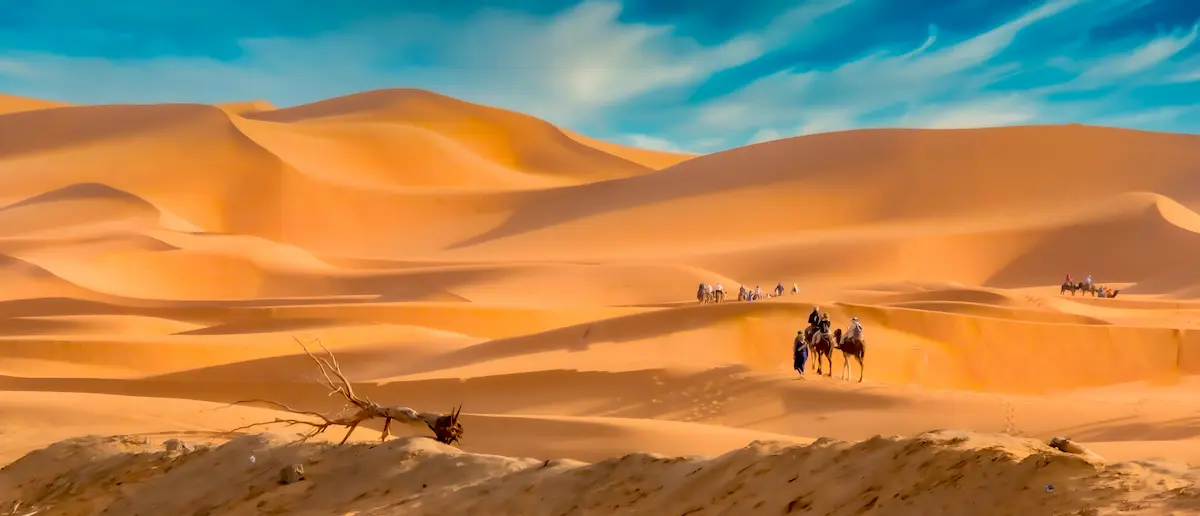
Erg Chebbi near Merzouga features 150-meter-tall golden dunes stretching 22 kilometers north to south. This is the iconic postcard scenery you see on Moroccan tourism posters. The sand here is fine and orange-red, rich in iron oxide. You’re 8 hours from Marrakech, 7 from Fes, 11 from Tangier. It’s the furthest desert region from major cities, which means longer travel but also the most dramatic landscape payoff.
Erg Chigaga near M’Hamid offers a wider, more remote wilderness feel. The dune field spans 40 kilometers and reaches heights up to 300 meters. Access requires a 1.5-hour 4×4 drive from M’Hamid across rocky hamada (stone desert) with no paved roads. You’ll see fewer tourists here. Mobile signal disappears 30 minutes into the drive. Erg Chigaga is best for travelers seeking isolation over convenience, willing to add an extra day to their itinerary. The Zagora region sits closer to Marrakech (6 hours) but offers flatter, rocky hamada with smaller dunes topping out at 30 meters. This is a stone desert, not the sweeping sand seas most travelers picture. Zagora works for time-pressed itineraries or families with young children who cannot handle long drives, but it won’t deliver the classic Sahara experience.
The key differentiator is simple. Only Merzouga (Erg Chebbi) and Erg Chigaga offer the erg experience, meaning vast seas of continuous sand dunes formed by wind over millennia. Zagora and Agafay (near Marrakech) are hamada, rocky desert plains with scattered dune patches. If your mental image of the Sahara involves climbing towering dunes and watching sand ripples extend to the horizon, Merzouga is worth the extra travel time. If you’re content with desert atmosphere without the extreme geography, Zagora saves you three hours each way.
Making It Worthwhile: How to Choose the Right Tour for You
Budget tours under 300 USD (3,000 MAD) typically involve long bus rides with 15 to 30 other travelers, large groups sharing the same camp, and standard tents with communal facilities. You’ll stop at fixed photo points (Ait Benhaddou, Todra Gorge) on a rigid schedule, eat buffet-style meals, and share camels in a caravan. These tours deliver the core experience (dunes, stars, camel trek) but sacrifice comfort and flexibility. Expect foam mattresses, thin blankets, and limited hot water.
Mid-range private tours between 300 and 700 USD (3,000 to 7,000 MAD) often include a private 4×4 or minivan, a dedicated driver-guide, and upgraded standard camps with better bedding and private tent bathrooms. You’ll have control over photo stops, lunch timing, and the ability to add detours (like Rissani’s Sunday livestock market or the Todra palm groves). The vehicle quality improves. You’ll get air conditioning that works, cushioned seats, and bottled water stocked throughout. Luxury tours above 700 USD (7,000 MAD) feature premium 4×4 Land Cruisers, handpicked expert guides fluent in your language, and luxury camps with king beds, en-suite bathrooms with rainfall showers, gourmet meals, and private dune access far from crowded zones. Some include a dedicated camp staff member assigned to your tent. Read our article about the comparison between standard vs luxury Sahara desert camp for an in-depth comparison.
Time-saver tip worth repeating: fly to Errachidia or Ouarzazate and start your desert tour from there, cutting drive time by half. Royal Air Maroc operates daily flights from Casablanca to Errachidia (1 hour), landing you 90 minutes from Merzouga instead of 9 hours. Round-trip flights cost around 150 EUR (1,500 MAD). For authenticity seekers, look for tours that include visits to Rissani market (operational every Sunday, Tuesday, and Thursday) where locals trade livestock, spices, and dates, or Khamlia village (5 kilometers from Merzouga) to hear Gnawa music performed by descendants of sub-Saharan traders. These additions cost nothing extra on private tours but require a guide willing to detour off the standard circuit. Check exact travel times from Marrakech before you commit to a departure city.
What Most Guides Get Wrong About Desert Prep
Most packing lists tell you to bring sunscreen and a hat. That’s obvious. What they skip is the critical detail about footwear. Sandals are a terrible choice for walking on dunes. The sand is either scorching hot (50°C surface temperature in summer afternoons) or freezing cold (below 5°C at dawn in winter). You need closed-toe shoes (trail runners or light hiking boots) for the camel departure point and camp walks. Bring flip-flops only for inside your tent or the shared bathroom area.
The shemagh (traditional desert scarf) isn’t a souvenir. It’s a functional gear. Wrapped correctly, it protects your nose, mouth, and neck from sand kicked up by wind or camel movement. Locals wear it year-round. You can buy one in Merzouga village for 40 to 60 MAD (4 to 6 USD), but guides often provide loaners. Cotton clothing is a poor choice despite the heat. Cotton absorbs sweat and stays damp, leaving you chilled after sunset when temperatures drop 20°C (36°F) within an hour. Merino wool or synthetic moisture-wicking fabrics regulate temperature better, keeping you cool during the day and warm at night without layering heavily.
Guides rarely mention that jeans become uncomfortable during long car rides and camel treks. Denim is heavy, stiff, and doesn’t breathe. Lightweight trekking pants with articulated knees (like those from Decathlon or REI) flex better when mounting camels and dry faster if you spill tea on them at camp. Even in spring and autumn, bring a warm jacket. Desert nights in March, April, October, and November regularly dip to 5°C (41°F). A fleece or down jacket packs small and becomes essential once the sun drops behind the dunes at 6:30 PM. You can find more details about what to pack for a Sahara Desert trip, as well as tips to plan your Sahara Desert trip from Marrakech beforehand.
When the Sahara Isn’t Worth It for You
If you have less than 3 days total in Morocco, skip the Sahara. The math doesn’t work. You’ll spend 2 full days driving (day 1 out, day 3 back), leaving only 1 night in the desert. That’s +60% of your trip in a car. Better to focus on depth in one region (Marrakech and the Atlas, or Fes and Chefchaouen) than rushing through a checklist.
Travelers with severe mobility issues should reconsider. Mounting a kneeling camel requires swinging your leg over a 1.5-meter-high saddle while the animal shifts its weight. Many camps sit 1 to 2 kilometers from where 4×4 vehicles stop, accessible only by camel or on foot through soft sand. Luxury camps sometimes offer 4×4 transfers directly to camp, but confirm this in advance. Standard camps assume camel capability. If you experience severe motion sickness, the 9-hour drive through mountain switchbacks and winding valleys will be miserable even with breaks. Consider flying into Errachidia or skipping the Sahara entirely in favor of coastal cities (Essaouira, Agadir) reachable by shorter, straighter roads.
Families with children under 5 years old often find the journey too demanding. Young kids struggle with long car rides without entertainment, the heat (or cold), and the lack of familiar food. Standard camp meals are tagine-based with limited kid-friendly options. Some luxury camps provide simpler dishes (pasta, grilled chicken) on request, but verify this when booking. If your travel style prioritizes boutique hotels with pools, daily spa access, and gourmet restaurant variety, the Sahara will feel like a downgrade. Desert camps are about the landscape and cultural immersion, not plush amenities. Even luxury camps are rustic by urban hotel standards.
So, Is the Moroccan Sahara Calling Your Name?
The Sahara is worth it if you value profound landscape experiences and cultural immersion over pure comfort and time efficiency. Its value skyrockets with proper planning: choosing the right season (March to May or September to November), the right desert region (Merzouga for dramatic dunes, Zagora for shorter drives), and investing in a tour that matches your comfort threshold. If you need luxury, pay for it. If you can tolerate basic facilities for one night to save 400 USD, standard camps deliver 80% of the experience.
The cons we’ve outlined (long drives, temperature extremes, basic toilets in budget camps) are real and non-negotiable. But they’re also manageable with the right expectations and route planning. Starting from Fes instead of Marrakech cuts two hours. Flying into Errachidia cuts the drive to 90 minutes. Booking a private tour eliminates crowded camps and rigid schedules. Every decision you make tilts the worth equation in one direction or another.
If our honest breakdown has you leaning towards yes, the next step is crafting the journey that maximizes the worth for you. We design private Sahara tours from Marrakech, Fes, and Tangier that focus on the moments you’ll find truly valuable: watching the Milky Way from your private dune access point, sharing tea with nomadic families near Hassilabied, and crossing the Atlas Mountains with photo stops dictated by light and landscape instead of a tour company’s schedule. Let’s design a private Sahara tour from your starting point that focuses on the moments you’ll find truly valuable.
📩 Contact us: contact@mementomorocco.com | +49 1522 3075977