Sahara Desert Camp Facilities: What to Expect (Beds, Bathrooms & Charging)
Imagine arriving at a Sahara desert camp after a camel trek, only to wonder: Is there a real bed? Will I have a private bathroom? Where do I charge my phone? These questions keep travelers awake long before they reach the dunes. The reality is that Sahara desert camp facilities vary wildly, from luxury tents with ensuite bathrooms to basic mattresses on sand floors with no electricity. By the end of this guide, you’ll know exactly what facilities are available in the Sahara Desert and beyond, how to prepare, and which camp type matches your comfort needs. Let’s get specific about what you can really expect when you sleep under the stars in Morocco’s desert.
Types of Desert Camps and Facility Levels (Luxury, Standard, Budget)
Not all desert camp amenities morocco are equal. The difference between luxury, standard, and budget camps is not subtle: it’s the difference between a private ensuite bathroom with hot water and a pit toilet shared among twenty people. Understanding these distinctions before you book determines whether you sleep comfortably or spend the night wishing you’d researched more carefully.
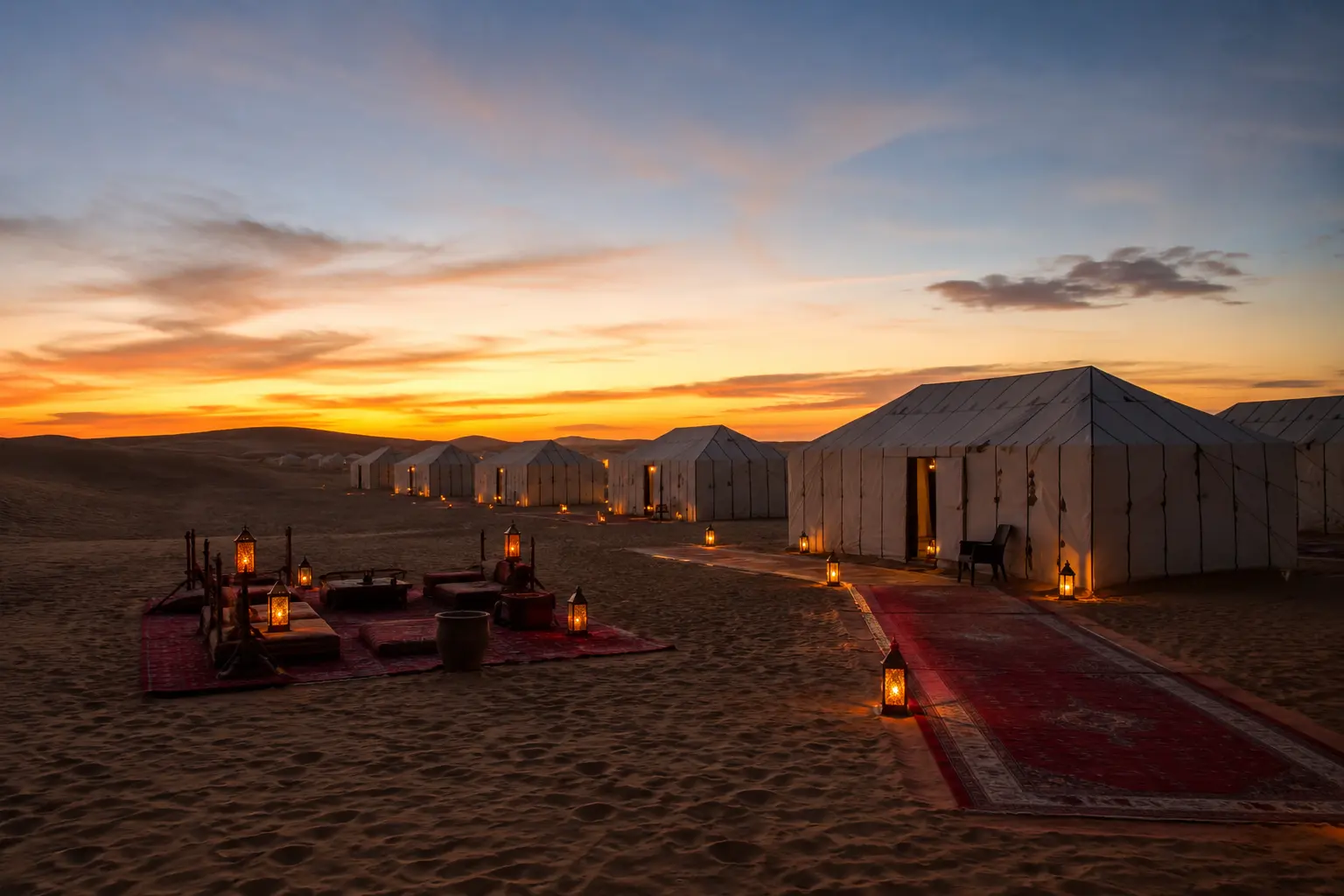
Luxury camps offer ensuite bathrooms with flush toilets, hot water showers, real beds with quality linens, and 24/7 electricity from generators or advanced solar systems. Expect to pay 800 to 1,200 MAD per night (roughly $80 to $120 USD). Standard camps cost 400 to 600 MAD per night and provide shared bathrooms with flush toilets, bucket showers (sometimes heated), foam mattresses on the floor, and limited electricity, usually solar-powered from 6 PM to 10 PM. Budget camps charge 200 to 300 MAD per night and offer basic mattresses on sand floors, pit toilets, no showers, and no electricity at all.
Location also matters. Camps in Erg Chebbi near Merzouga village tend to have more reliable infrastructure because they are closer to water sources and power supply. Camps in remote Erg Chigaga rely entirely on solar panels and water trucks, which can mean longer gaps between facility maintenance. Check our detailed guide on Standard vs luxury Sahara Desert camps to learn more about the differences, and help you take the right decision.
What Others Get Wrong About Camp Classifications
Many online guides claim that all camps labeled “luxury” offer similar standards. This is false. A luxury camp in Erg Chebbi with year-round access to Merzouga’s water supply will have more consistent hot water than a luxury camp deep in Erg Chigaga, which relies on solar heating and trucked-in water. The label “luxury” tells you intent, not infrastructure. Ask specific questions: What powers the showers? How many guests share each bathroom? What is the water heating schedule?
Sleeping Arrangements: Beds and Bedding
The bed you sleep on in a Sahara camp depends entirely on which camp category you book. Luxury camps provide queen or king beds with firm mattresses, clean cotton sheets, pillows, and duvets or heavy blankets. These beds are comparable to what you’d find in a mid-range Moroccan hotel. Standard camps place foam mattresses directly on carpeted floors, usually with one fitted sheet, a flat sheet, and two or three wool blankets. The mattresses are rarely replaced daily, so expect some dust.
Budget camps offer the bare minimum: a thin foam mattress or sleeping pad on the tent floor, sometimes just a wool blanket. If you’re traveling in winter (November through February), nights in the Sahara drop to 2°C to 5°C. One blanket will not be enough. Ask your camp for extra blankets when you book, and most will provide them free of charge. Pack your own sleeping bag liner if you’re sensitive to fabric cleanliness, especially in standard or budget camps.
In summer (June through August), temperatures inside tents can exceed 35°C during the day, but nights cool to a comfortable 18°C to 22°C. A single sheet is often all you need. For year-round comfort advice, check our complete Sahara desert weather, and Sahara Desert packing list, which includes bedding tips based on travel month.
Why Mattress Quality Matters More Than You Think
A bad mattress ruins sleep, and poor sleep ruins your entire desert experience. If you have back pain or sleep sensitivity, invest in a luxury camp. The difference between a 10 cm foam pad on a sand floor and a proper mattress is not cosmetic. It’s the difference between waking up refreshed for sunrise over the dunes and waking up sore and irritable. This is not an exaggeration. We’ve heard it from dozens of travelers who tried to save money and regretted it.
Bathrooms: Showers, Toilets, and Hygiene
Bathroom facilities in Sahara desert camps range from private ensuite bathrooms with hot showers to shared pit toilets with little running water. Luxury camps offer private bathrooms inside or directly attached to your tent. These include flush toilets, sinks with running water, and hot showers powered by solar water heaters or gas systems. Some luxury camps provide soap, shampoo, and towels. Water pressure is lower than in hotels, but the water is usually hot from 6 PM to 9 PM when solar panels have charged throughout the day.
Standard camps have shared bathroom blocks with flush toilets and bucket showers. A bucket shower means a large plastic bucket filled with warm water (heated over a fire or by solar panels) and a smaller scoop bucket for pouring water over yourself. It works, but it’s not comfortable if you’re used to Western-style showers. Toilet paper is provided in most standard camps, but supplies run low by evening if many guests arrive. Always carry your own biodegradable toilet paper and wet wipes.
Budget camps have pit toilets (a hole in the ground, sometimes with a squat toilet structure) and no showers at all. You may be offered a bucket of cold water for washing your face and hands. Hygiene standards vary wildly. If you’re traveling in a budget camp, treat it as a true backcountry experience and adjust expectations accordingly. For more on safety and hygiene in remote desert areas, read our guide on whether it’s safe to go to the desert and read more about snakes, scorpions in the Sahara Desert for peace of mind (it’s not dangerous at all).
The Reality of Water Scarcity
Water is scarce in the Sahara Desert. Even luxury camps limit shower time to five or ten minutes. Standard camps heat water in batches, so if you arrive late after other guests have showered, you may only get lukewarm water. Always ask your camp what time water is heated and plan your shower accordingly. Bring biodegradable wet wipes and hand sanitizer as backup. Even luxury camps occasionally experience plumbing issues because desert sand clogs pipes and solar systems fail during cloudy weather.
Electricity and Charging: Power in the Desert
Sahara camp electricity infrastructure depends on camp type and remoteness. Luxury camps run 24/7 generators or advanced solar battery systems, providing multiple electrical outlets in each tent. You can charge phones, cameras, laptops, and other devices at any time. Outlets are European two-pin (Type C or Type F), so bring a universal adapter if your devices use different plugs.
Standard camps operate on limited electricity, usually from 6 PM to 10 PM when a central generator runs or when solar batteries have stored enough charge. Most standard camps provide a central charging station in the common dining tent where you can leave devices under staff supervision. Charging is slower than at home because power output is lower and many guests share the same circuits. A fully drained phone may only reach 60% charge in four hours.
Budget camps have no electricity. You rely entirely on power banks. A 20,000 mAh power bank can fully charge a smartphone three to four times, which is enough for a two-night desert trip if you use your phone sparingly. Solar chargers work in the desert but are slow and only effective during peak sunlight hours (10 AM to 3 PM). If you plan to use your phone for photography, navigation, or entertainment, arrive with a fully charged power bank.
Why You Should Not Rely on Camp Electricity Alone
Even luxury camps experience power outages. Generators break down, solar panels get covered in sand during windstorms, and batteries fail. If you depend on your phone for travel documents, tickets, or emergency contact, always carry a backup power bank with at least one full phone charge stored. This is non-negotiable. The nearest town with reliable electricity may be two hours away by 4×4.
Additional Amenities: Wi-Fi, Food, Heating & More
Beyond beds and bathrooms, what else do Sahara camps offer? Luxury camps often provide Wi-Fi, though connection speeds are slow and intermittent because they rely on satellite or weak 3G/4G signals from Merzouga. Do not expect to stream videos or upload large photo files. Wi-Fi is sufficient for messaging apps like WhatsApp but may not load Instagram or email attachments reliably. Luxury camps also include full Moroccan dinners (tagine, couscous, salad, bread, fruit), campfire entertainment with Berber music and drumming, and heating or air conditioning units in tents.
Standard camps serve basic tagine dinners, bread, Moroccan Mint tea, and sometimes fruit. Meals are filling but not gourmet. Campfires are standard, and most camps organize evening music sessions. Wi-Fi is rare in standard camps. If connectivity matters, choose a camp within 5 km of Merzouga town, where mobile data (3G or 4G) sometimes works on the dunes if you climb high enough. Heating in winter is limited to wool blankets and the communal fire. Some standard camps provide a gas or electric space heater in the dining tent but not in individual sleeping tents.
Budget camps offer simple meals (often just tagine and bread), a fire, and no extra amenities. Breakfast across all camp types usually includes Moroccan bread, jam, honey, olives, cheese, tea, and coffee. Expect this meal between 7 AM and 9 AM before most guests depart for sunrise excursions. For a full breakdown of what to expect on desert tours, including meals and activities, visit the complete guide to Sahara desert tours in Morocco.
Why Wi-Fi in the Desert is Overrated
Most travelers say they want Wi-Fi, but the Sahara is one of the few places left where you can fully disconnect. Slow, unreliable internet forces you to be present. If you need reliable connectivity for work or emergencies, book a camp within signal range of Merzouga and buy a local SIM card with data before you leave town. Maroc Telecom and Orange Morocco offer decent coverage near Erg Chebbi dunes, though speeds drop to 2G in remote areas.
How to Choose the Right Camp Based on Facility Preferences
Choosing the right desert camp starts with honest self-assessment. If you need a private bathroom, consistent hot water, and a real bed, book a luxury camp. If you can handle shared facilities and limited electricity in exchange for lower cost, standard camps work well. If you’re young, adventurous, and comfortable roughing it, budget camps offer the most authentic backcountry experience. Season matters too: winter (November to February) demands better heating, while summer (June to August) makes basic camps more tolerable because you spend evenings outside anyway. If you are planning to visit Morocco and not sure when is the best time to, you can read our block about the best time to visit Morocco for more details.
Location also impacts facility quality. Camps closer to Merzouga village (within 10 km) benefit from easier access to water, power, and supplies. Remote camps deep in Erg Chigaga or far from any town rely entirely on solar power and trucked-in water, which means less reliable facilities. Always read recent Google or TripAdvisor reviews for specific camps. Look for mentions of water temperature, cleanliness, and whether electricity worked as promised.
Email the camp directly with specific facility questions before booking. Most camps respond within 24 hours and appreciate the chance to clarify expectations. Ask: What time is water heated? How many guests share each bathroom? What is the backup plan if solar panels fail? A camp that answers these questions transparently is more trustworthy than one that dodges them or provides vague reassurances.
Ready to Experience Sahara Desert Camping with the Right Facilities?
Sahara desert camp facilities vary widely, but knowing what to expect lets you choose a camp that matches your comfort level. Whether you prioritize a real bed, a private bathroom, or reliable charging, there is a camp for you in the Sahara Desert. The key is to ask specific questions, read recent reviews, and book based on honest facility descriptions rather than marketing language.
Now that you know what to look for, it’s time to book a Sahara desert camp that fits your needs. Do you want to wake up in a luxury tent with an ensuite bathroom and a view of Erg Chebbi’s dunes? Or are you ready to rough it under the stars with nothing but a blanket and a campfire?
Our private tours from Marrakech and Fes to the Sahara include carefully selected camps with verified facilities. We match you with luxury desert camp experiences in Merzouga or budget-friendly options in Erg Chigaga based on your preferences. You’ll never arrive wondering if the bathroom works or the bed is real. We’ve been there, we’ve slept in these camps, and we only recommend what we’d choose for ourselves. Explore our private Sahara desert tours and book a camp with the facilities you need.
Contact us: contact@mementomorocco.com | +49 1522 3075977