What is Fez Famous For? Landmarks, Culture and Surprising Sides
The call to prayer rolls across Fes el-Bali at 5:47 AM and bounces off 9,000 alleys before reaching you on a leather shop rooftop, mint leaves crushed in your fist against the smell rising from the dye pits below. Ask a Moroccan what Fez is famous for and they will tell you it is the soul of the country. That is not marketing. Fez carries Morocco’s oldest university, its deepest religious identity, and its most unfiltered medina life, all inside 540 hectares that no car has entered in living memory. This guide tells you exactly what Fez is known for, what each landmark actually feels like to visit, what it costs, and whether it belongs in your itinerary.
Fez is famous for four things that define Morocco at its core: its medieval UNESCO-listed and car-free medina (Fes el-Bali), the world’s oldest university (Al-Qarawiyyin, founded in 859 AD), its centuries-old leather tanneries, and its role as the country’s spiritual and intellectual center. What makes Fez different is not just these landmarks, but the fact that they are still active parts of daily life, not preserved attractions.
What is Fez Famous For: A Quick Overview
Fez is the Imperial Cities cluster’s most demanding stop, and also its most rewarding. The city holds more verifiable records and firsts than any other in Morocco, which is why it sits at the centre of any serious Morocco itinerary.
- Fes el-Bali medina: The world’s largest car-free urban area, covering 540 hectares with over 9,000 streets and a resident population of roughly 200,000 people.
- Al-Qarawiyyin University: Founded in 859 AD by Fatima al-Fihri, a Tunisian woman. Guinness World Records confirms it as the oldest continuously operating university on earth.
- Chouara Tannery: An 11th-century leather dyeing site in Fes el-Bali, still operating with the same pit-dyeing methods used a thousand years ago.
- Bou Inania Madrasa: A 14th-century Marinid masterpiece with a functioning hydraulic clock, open to non-Muslim visitors for 20 MAD (approximately $2 USD).
- Fes Festival of World Sacred Music: Held each June, this internationally recognised festival draws artists from across the world into the medina’s historic venues.
- Morocco’s religious capital: Hundreds of mosques and madrasas are concentrated here, giving Fez a spiritual density you feel before you understand it.
Keep this list as a mental checklist before you arrive. The medina’s intensity can make you forget what you came to see, and it helps to have a clear priority order before Bab Boujloud swallows you whole.
Fez Medina Guide: The World’s Largest Car-Free Medina
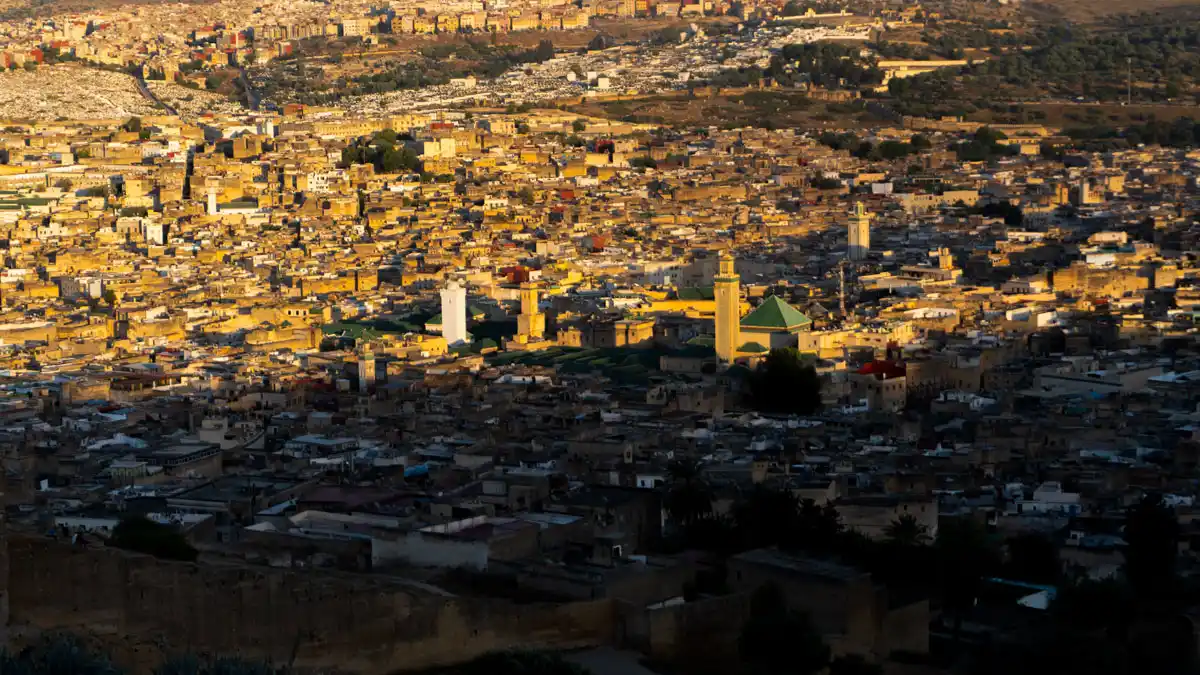
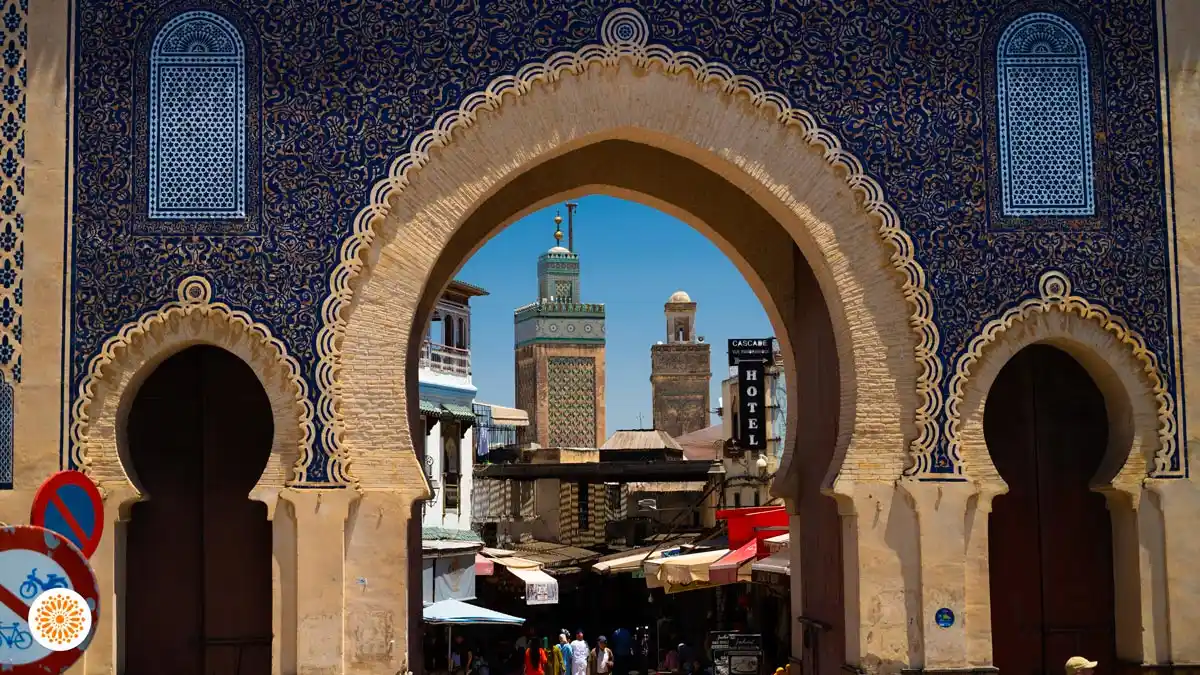
Fes el-Bali is not maze-like in the romantic sense travel writers prefer. It is genuinely disorienting in a way that can exhaust you by midday if you have no system. The medina covers 540 hectares, runs through roughly 9,000 streets, and is entered through several historic gates: Bab Boujloud (the Blue Gate, the most photographed), Bab Rcif on the eastern side, and Bab Guissa to the north.
Donkey carts are the primary transport inside Fes el-Bali, not a tourist attraction. When you hear shouting behind you on a narrow alley, step into the nearest doorway immediately. Google Maps works on the main arteries but fails completely in the interior lanes; download Maps.me with the Morocco offline map before you arrive. A local guide is worth the cost on your first visit, not because you cannot find things alone, but because the hidden workshops (copper smiths, silk weavers, wood carvers) are behind unmarked doors a guide opens without knocking.
Arrive at Bab Boujloud at 8 AM. The light is low and golden, the alleys are quiet enough to photograph, and you can watch the medina activate over the next two hours in real time. By 11 AM the same alley is a different experience entirely. Plan for four to six hours to cover the main arteries; a full day if you want to go deeper.
What Most Online Guides Get Wrong About the Fez Medina
Most articles describe the Fez medina as “impossible to navigate alone” and recommend hiring a guide immediately. This overstates the difficulty and undersells what wandering independently teaches you. The medina has three or four main commercial arteries that are genuinely easy to follow; it is only when you leave them deliberately that you get productively lost. Getting lost in Fes el-Bali is how you find the café where a retired teacher plays oud on Thursday afternoons, or the courtyard where a family weaves Fez blue pottery tiles by hand. The people who find the medina overwhelming are usually the ones who tried to follow a rigid itinerary through it. Walk one main artery end to end on your first morning. On your second morning, leave the artery. The experience changes completely.
Al-Qarawiyyin University Fez: The Oldest in the World
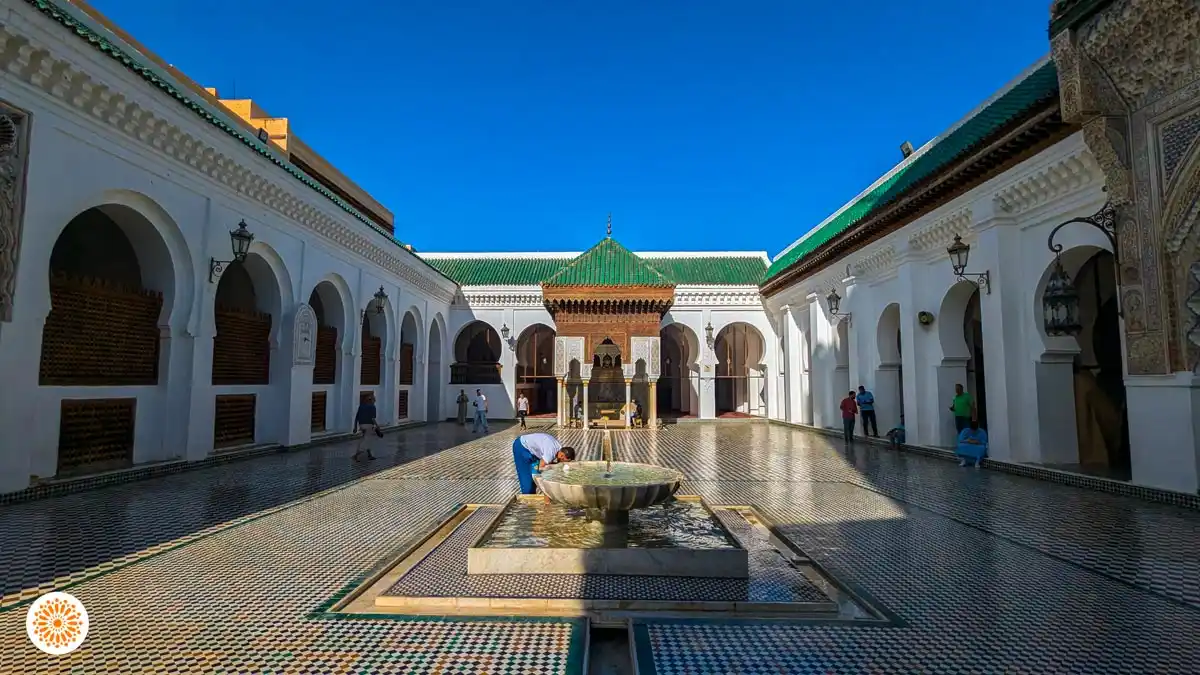
Al-Qarawiyyin was founded in 859 AD by Fatima al-Fihri, a woman from Kairouan in present-day Tunisia, who used her inheritance to build both the mosque and the university beside it. This is not a commonly disputed fact, but it is one many visitors are surprised by. The library holds 4,000 manuscripts, including a 9th-century Quran written on gazelle skin and a copy of Ibn Khaldun’s Muqaddimah in the author’s own handwriting.
Non-Muslims cannot enter the mosque itself, but the main doors open during prayer times and you can stand directly opposite and see the vast prayer hall lit for the faithful. The best moment for this is just before sunset prayer (maghrib), when the interior light turns warm and the sound of Quranic recitation carries into the small square outside. The al-Attarine Madrasa sits directly adjacent, is open to all visitors, and costs 20 MAD (about $2 USD). Its carved stucco and zellij tilework are among the finest examples of Marinid decorative art in Morocco.
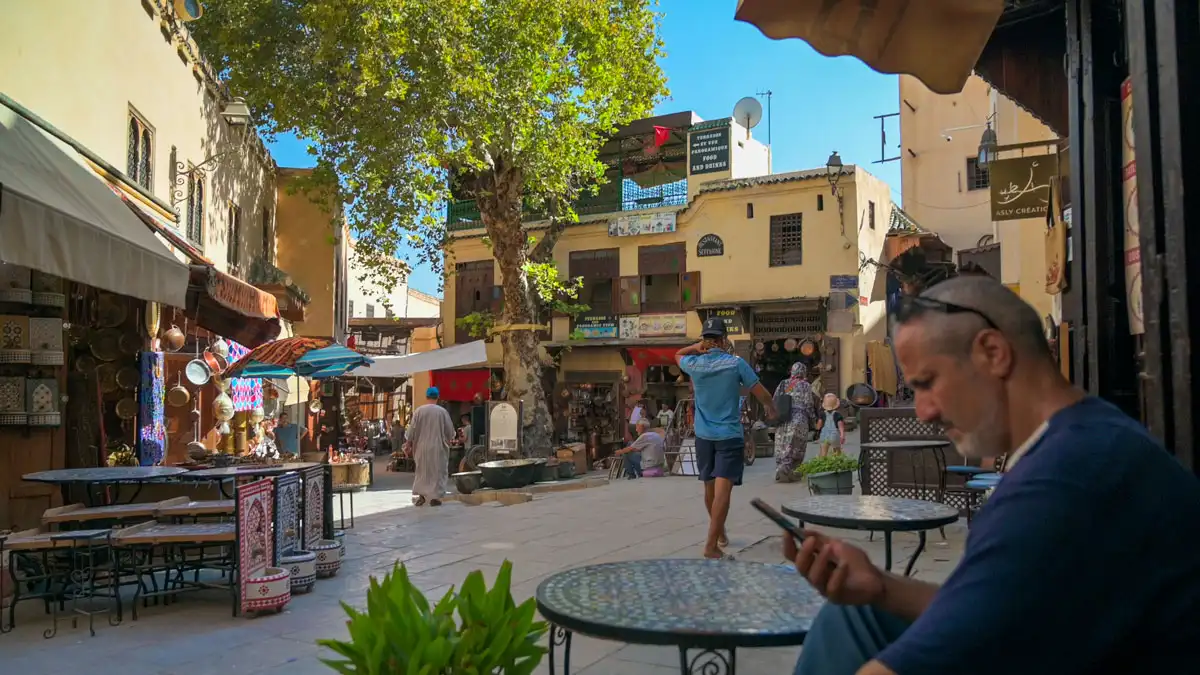
Stand at Place Seffarine, the copper-smiths’ square just outside the mosque, for five minutes. You will hear recitation from inside Al-Qarawiyyin and the rhythmic hammering of brass artisans at the same time. Two of Fez’s oldest traditions, running in parallel, separated by a single wall. That specific combination exists nowhere else in Morocco.
Fez Tannery Guide: Smells, Colours and What to Actually Buy
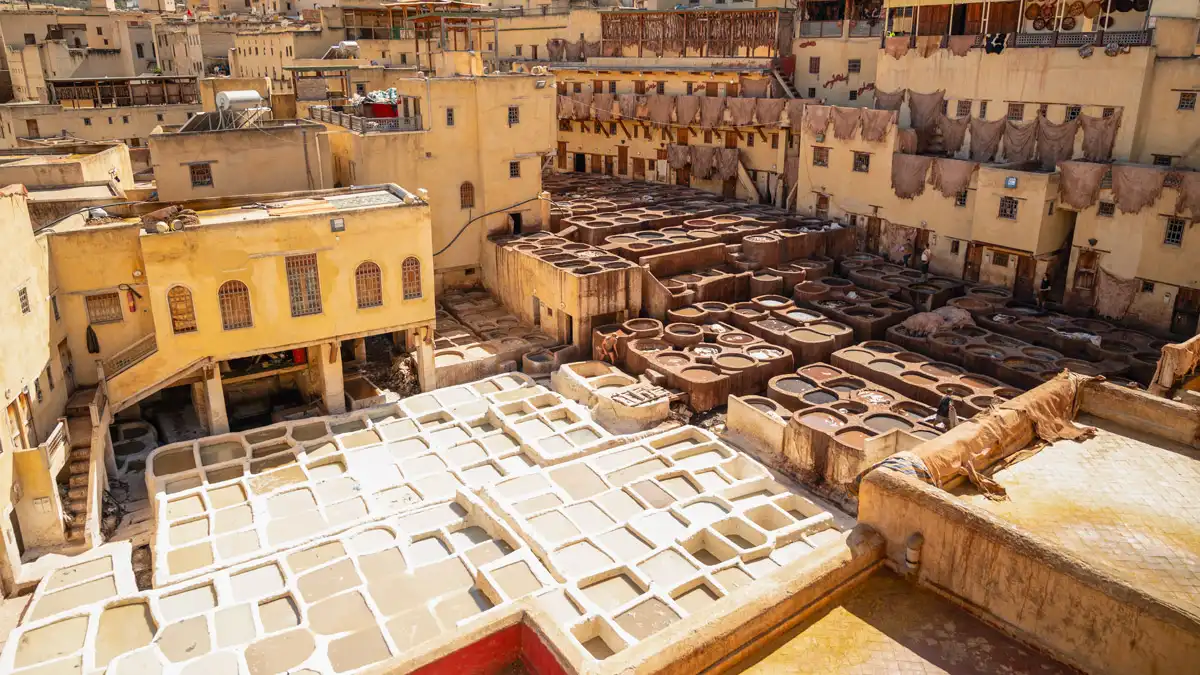
Chouara Tannery in the Adoua el-Andalus quarter is the largest of Fez’s three tanneries and the oldest, with over 300 dye pits in operation since the 11th century. The colours shift by season: poppy red and saffron yellow in summer, deeper indigo and forest green through autumn. Entry is through the leather shops surrounding the tannery; most charge between 10 and 20 MAD (roughly $1 to $2 USD) per person or ask that you browse their goods afterward. Both are fair.
The smell is strongest between June and September when heat intensifies the combination of pigeon dung (used to soften hides), natural dyes, and raw leather. Morning visits before 10 AM reduce the intensity slightly. The mint leaves handed out at the entrance are not a tourist gimmick; hold a full bunch directly under your nose and breathe through it. Leather goods to buy here include babouches (traditional slippers) starting at 80 to 120 MAD ($8 to $12 USD) for standard quality, and leather poufs from 350 MAD ($35 USD) upward. Start any negotiation at 40% of the asking price and expect to settle around 60 to 70%.
After the tannery, walk three minutes to Souk el-Henna (the Henna Souk). Women sell natural cosmetics, kohl, argan oil, black soap, and traditional remedies here with zero tourist pressure and prices that reflect what locals actually pay. It is the most honest shopping experience within a ten-minute walk of the tannery and almost no travel article mentions it.
Fez Architecture Landmarks: Mosques, Madrasas and the Royal Palace
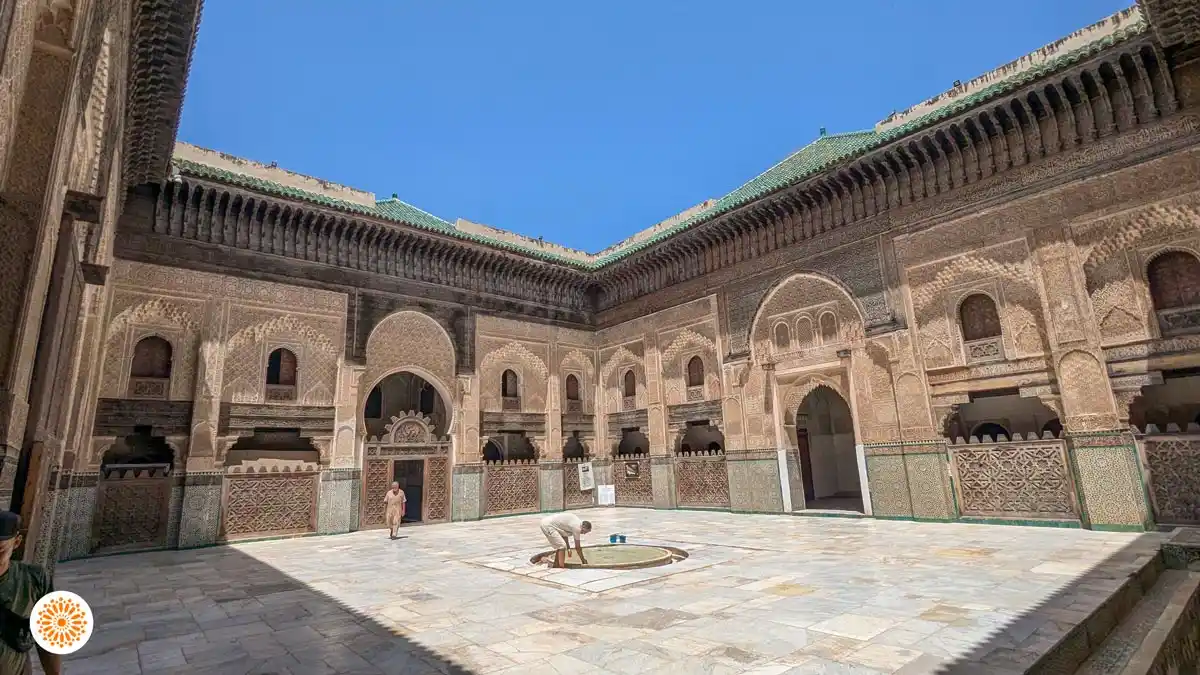
The Bou Inania Madrasa on Talaa Kebira is the one religious building in Fes el-Bali that non-Muslims can enter fully. Built between 1350 and 1357 under Sultan Abou Inan Faris, it contains a marble courtyard, carved cedarwood screens, and a hydraulic clock on the exterior wall that used to strike the hours using metal weights and water. Entry is 20 MAD ($2 USD); arrive before 9 AM to have the courtyard largely to yourself. The al-Attarine Madrasa, a five-minute walk toward Al-Qarawiyyin, is smaller but quieter and has exceptional zellij detail at eye level rather than overhead, which makes it easier to study closely.
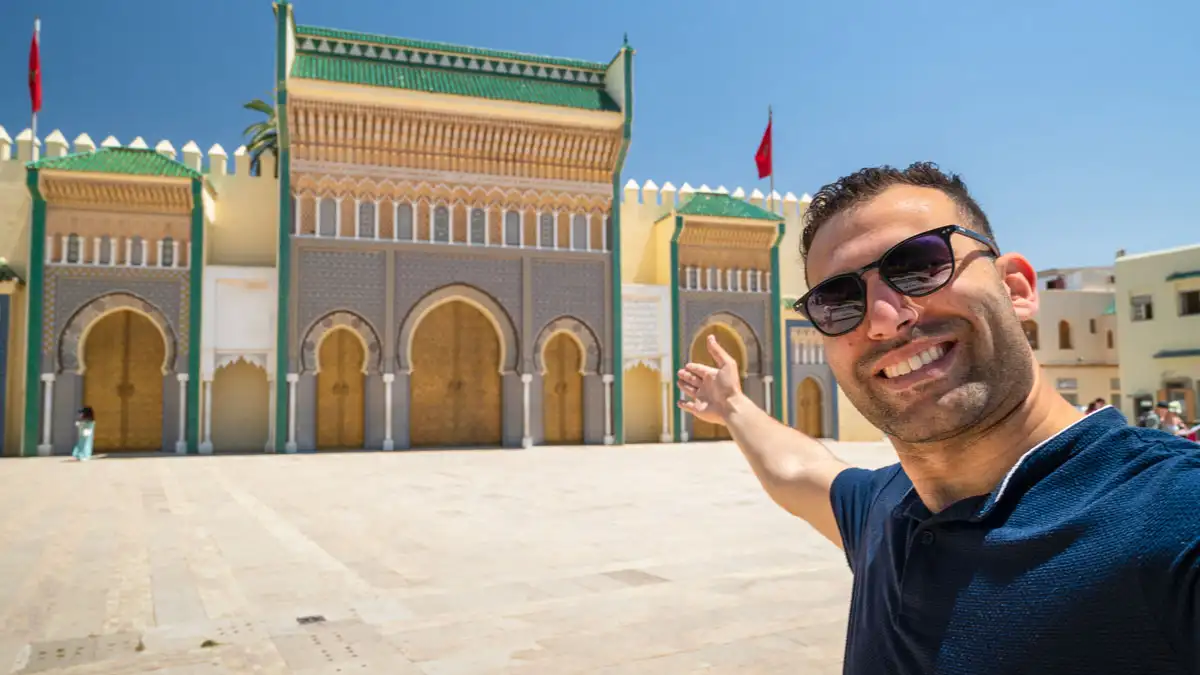
The Royal Palace of Fez sits outside the medina in the Mellah district, the historic Jewish quarter. You cannot enter the palace, but the seven sets of brass doors facing Place des Alaouites are worth the twenty-minute walk from Bab Boujloud. Photograph them between 5 and 6 PM when the low sun turns the brass a deep gold. There is rarely anyone there at that hour, which is unusual for one of the most photographed facades in Morocco. The Mellah itself, a fifteen-minute walk from the palace, has a distinct architectural character: narrower balconies, Hebrew inscriptions above some doorways, and a quieter pace than the medina proper.
Most mosques in Fez are closed to non-Muslims, including Al-Qarawiyyin and the Andalusian Mosque across the river. Their exteriors, however, are worth finding. The Andalusian Mosque at the eastern end of Fes el-Bali has an ornate 13th-century portal that few visitors reach because most tours turn back at the tanneries.
Is Fez Worth Visiting? An Honest Answer by Travel Style
Fez is worth visiting if you travel to understand places, not just to photograph them. The medina is physically demanding: you will walk four to eight kilometres on uneven stone surfaces, navigate without signage, manage persistent touts near the main gates, and process a sensory load that has no equivalent in any other Moroccan city. If you find Marrakech overwhelming, Fes el-Bali will be more so. That is not a reason to skip it. It is a reason to prepare differently.
- Go if: You want to see a living medieval city, not a preserved replica. Fes el-Bali has 200,000 residents going about their actual lives inside what tourists call an attraction.
- Go if: You are interested in Islamic architecture, craft traditions, or the history of North Africa. Fez rewards intellectual curiosity at every corner.
- Skip if: You have only one or two days in Morocco and cannot handle a full day of walking on uneven ground in a city that gives you no flat rest points.
- Skip if: You get claustrophobic in crowds or in tight covered spaces. Several sections of the main souk have no natural light and ceiling clearance under two metres.
- Minimum stay: Two full days to cover the main sights without rushing. Three days to add a half-day trip to Meknes (56 km away) or the cedar forests of Azrou in the Middle Atlas.
If you are undecided, base yourself in Fez for two nights and pair it with one night in Chefchaouen (approximately 200 km northwest). The contrast between the two cities clarifies both of them in a way that neither achieves alone.
Which Side of Fez Will You Explore First?
Fez is famous for being Morocco’s spiritual, intellectual, and artisanal core; a city that does not perform for visitors but simply continues being itself at full volume. Whether you are drawn by the 9,000 alleys, the oldest university on earth, or the dye pits at Chouara, the real draw is the unfiltered human rhythm of a medina that has not fundamentally changed its function in seven centuries.
The question is not whether Fez is worth it. The question is whether you want the version of Morocco that challenges you most and gives back the most in return.
A guided Fes medina tour changes the experience completely; you move through the same alleys as every other visitor but through doors most people never find. We also run private Fes to Chefchaouen day trips for those who want both cities without the logistics, and multi-day routes from Fes into the Sahara or Fez-Sahara-Marrakech that follow the old caravan road through Ifrane and Midelt. Design your private Fez experience; tell us what fascinates you most, and we will craft the route.
Contact us: contact@mementomorocco.com | +49 1522 3075977