Driving to the Sahara Desert: Safety, Road Conditions & Driver Tips
You’re gripping the steering wheel on a narrow mountain road, glancing at the cliff edge 300 meters below, asking yourself: Is this safe? If you’re researching driving to Merzouga safety, you’re likely imagining hairpin turns, remote desert stretches, and police checkpoints you can’t predict. The truth is simpler. The 350 km route from Marrakech to Merzouga is entirely paved, well-traveled, and manageable for confident drivers who prepare properly. By the end of this guide, you’ll know exactly what to expect on each section of the road, from Tizi n Tichka switchbacks to police checkpoints, so you can drive with confidence and avoid common surprises.
Marrakech to the Sahara Desert Road Conditions: Section-by-Section Breakdown
The 350 km drive from Marrakech to the Sahara Desert (Merzouga) breaks into four distinct segments, each with different surface quality, traffic patterns, and seasonal hazards. From Marrakech to Aït Benhaddou (100 km, 3 hours), the road is busy with tourist traffic heading to the famous kasbah. From Aït Benhaddou to Ouarzazate (30 km, 45 minutes), you’ll find fast, smooth asphalt with minimal curves.
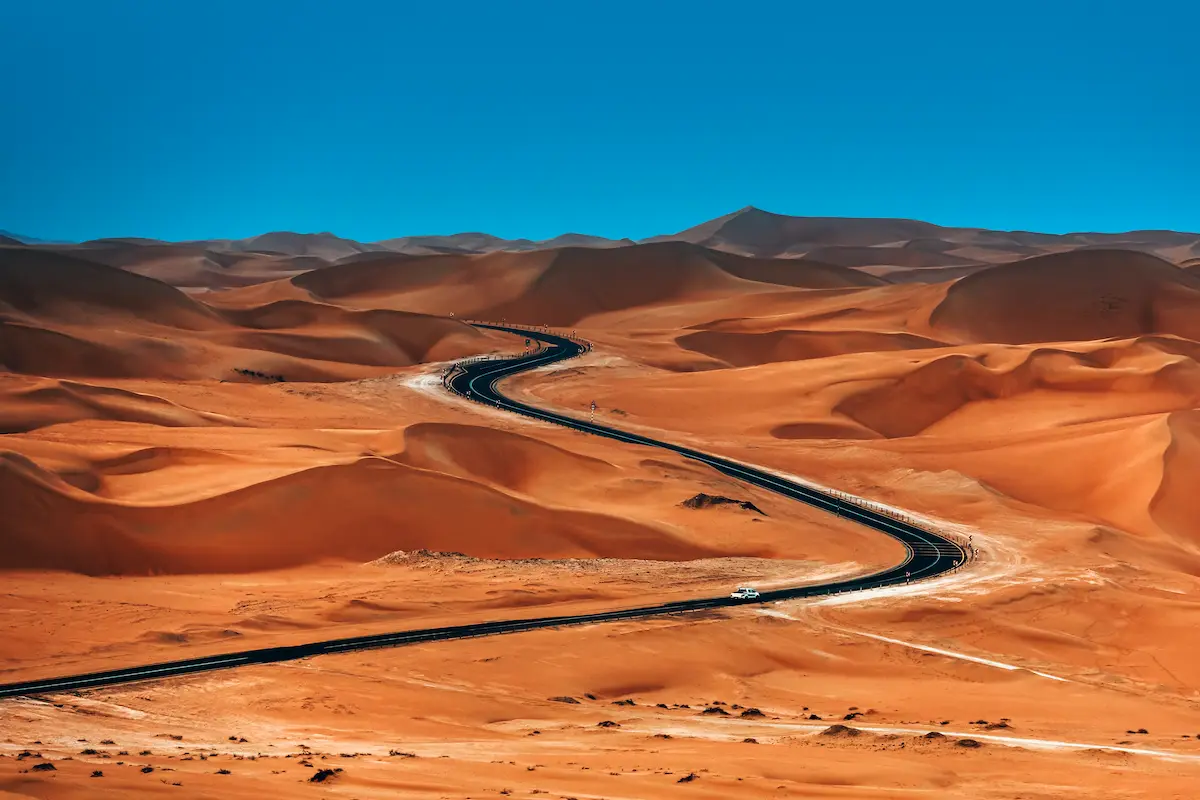
From Ouarzazate to Boumalne Dades (110 km, 3.5 hours), the road quality is excellent, newly resurfaced as of 2023 by Morocco’s Ministry of Transport. From Boumalne Dades to Tinerhir (50 km, 1h15 minutes), the road narrows slightly, with some potholes near the village of Msemrir, especially after winter rains. From Tinerhir to Merzouga (60 km, 1 hour), you’ll drive a straight desert road with few gas stations and intermittent cell coverage.
Near the village of Skoura, the road passes through a palm oasis that often has loose sand on the surface after windstorms. Reduce speed below 60 km/h in winter and spring when sand drifts cross the asphalt. The last reliable gas station before Merzouga is in Tinerhir, 80 km from your destination. Fill up there even if your tank is half full. Marrakech to the Sahara desert distance and travel time vary depending on stops, but expect 9 to 10 hours of total driving without extended breaks.
Tizi n Tichka Pass Driving Tips: How to Conquer the Atlas Switchbacks
The Tizi n Tichka pass climbs from Marrakech at 450 meters to 2,260 meters over 60 km of continuous hairpin turns. You’ll encounter over 30 switchbacks on the steepest section, most of them blind curves with no guardrails. Honk before each blind turn to warn oncoming trucks. Use second gear on the ascent to avoid clutch burn and overheating, especially in summer (April to October).
Truck traffic is frequent on the ascent. Slow-moving cargo trucks crawl at 20 km/h, and there are designated pullouts every 500 meters where you can overtake safely. If a truck is behind you and you’re driving slowly, use these pullouts to let it pass. The best time to cross is early morning. Depart Marrakech by 7:00 AM to avoid afternoon clouds and fog in winter, which reduces visibility to less than 50 meters.
The road width narrows in several places with drop-offs on both sides. Maintain a speed of 20 to 30 km/h on the tightest corners. On the descent, use third gear with engine braking instead of riding the brakes, which overheat and lose effectiveness. If you feel dizzy or carsick, pull over at the viewpoint near the top (GPS: 31.3066° N, 7.4070° W), just before the pass summit, and walk around. The fresh air and altitude will reset your equilibrium. For those who prefer to skip the stress of navigating these turns, consider private Sahara desert tours from Marrakech with experienced drivers who know every curve.
Rental Car in the Sahara: Do You Really Need a 4×4?
A regular sedan handles the paved road to the Sahara Desert without issue. All national roads are asphalt, including the N9 through Ouarzazate and the R702 to Tinerhir. However, the last 5 to 10 km leading to some desert camps are graded gravel or packed sand. A 2WD car can manage these if you drive slowly (20 to 30 km/h) and avoid deep ruts. Direct access to the Erg Chebbi dunes requires a 4×4 or a local driver with experience.
Rental prices in Marrakech range from 300 to 600 MAD per day (30 to 60 USD) for a small car like a Dacia Logan or Peugeot 208. A 4×4, like a Dacia Duster or Toyota Land Cruiser, costs 800 to 1,200 MAD per day (80 to 120 USD). Most rental contracts forbid off-road driving, meaning any damage caused by sand or rough terrain voids your insurance. Check the fine print or ask for an additional off-road waiver in writing. You can check our article on Morocco trip costs to better budget for your visit to Morocco.
Popular rental companies in Marrakech include Hertz, Avis, and local agencies like Locationmaroc and Medcar. Before renting, ask the agency if they allow navigation into the Erg Chebbi dunes area. Some prohibit it outright. If they say yes, get it written on the contract, not just verbally. Some camps are accessible by sedan if you drive carefully on the graded access road. Camps deeper in the dunes require 4×4 or transfer by the camp’s vehicle, or by camel. It is advisable to include a tire pressure gauge, as under-inflated tires increase the risk of punctures on gravel roads.
Police Checkpoints in Morocco: What to Expect on the Sahara Desert Route
You’ll pass 5 to 6 police checkpoints between Marrakech and the Sahara Desert, typically near town entrances like Ouarzazate, Boumalne Dades, and Tinerhir. Checkpoints are staffed by both police (sûreté nationale) in urban areas and gendarmerie (royal gendarmerie) in rural zones. Gendarmerie are more likely to ask for documents and inspect your car briefly. Most checkpoints last 30 seconds: the officer glances at your passport or rental contract and waves you through. You can find good advice for visiting Morocco in our article.
Required documents are your passport (original or a color photocopy), a valid driver’s license (an international driving permit is recommended but not always required if your license is in the Roman alphabet), and the car rental contract. Keep these in a clear plastic folder within arm’s reach while driving. Fumbling for papers looks suspicious and invites more questions. Common questions in French or Arabic include “Où allez-vous?” (Where are you going?) and “D’où venez-vous?” (Where are you from?) Answer calmly: “Sahara/Marrakech” and “Je suis touriste de [country].”
If an officer indicates a fine or requests money without explaining the violation, politely ask for an official receipt in French: “Puis-je avoir un reçu officiel, s’il vous plaît?” This usually ends the request immediately, as most minor infractions (like slight speeding) don’t warrant a formal fine. Real traffic violations (running a red light, dangerous overtaking) result in written fines of 300 to 500 MAD (30 to 50 USD), payable at a bank or on the spot. Over 200 clients have driven this route with our pre-trip guidance, and none have faced serious issues at checkpoints. The biggest surprise for most is how straightforward they are if you have your papers ready and say “Bonjour” with a smile. Is Morocco safe to travel to in 2026? addresses broader safety concerns beyond driving.
Pre-Departure Checklist: Safety Tips Before Driving to the Sahara Desert
Before leaving Marrakech, inspect your rental car thoroughly. Check tire tread depth (minimum 3 mm), coolant level (open the cap only when the engine is cold), oil level, and confirm the spare tire is inflated, and the jack is functional. Test the air conditioning in summer (June to August, when temperatures exceed 45°C) and the heater in winter (December to February, when nights drop below 0°C). If anything looks worn or damaged, request a different vehicle or document it in writing with the rental agency.
Download offline maps of the entire route before leaving. Google Maps and Maps.me both allow offline downloads of the entire region. The stretch between Tinerhir and Merzouga (Sahara Desert) has zero cell signal for at least 20 km, and GPS satellites still work offline. Save the location pins for gas stations: Marrakech (everywhere), Ouarzazate (reliable stations near the center), Boumalne Dades (last big station before Merzouga), and Tinerhir (small but functional). After Tinerhir, there are no stations for 80 km.
Emergency numbers in Morocco are 19 for the police, 15 for the SAMU ambulance, and 112 for general emergency from a mobile phone. Write these down on paper in case your phone dies. Mobile coverage is good in Marrakech and Ouarzazate, intermittent on Tizi n Tichka, and nonexistent between Tinerhir and Merzouga except near villages like Rissani. Carry at least 3 liters (2 bottles of Sidi Ali) of drinking water per person, snacks (dates, nuts, biscuits), a blanket (for winter breakdowns), and a basic tire repair kit (plug kit and portable air compressor, available at hardware stores in Marrakech for 200 to 300 MAD). Temperature extremes are real: summer days can exceed 45°C, and winter nights can drop below 0°C. Plan according to the weather. The Erg Chebbi desert and Erg Chigaga guide for your arrival will help you prepare for what to do once you reach the dunes.
What Most Blog Guides Get Wrong About Driving to the Sahara Desert
Most travel blogs say the road to the Sahara Desert is “challenging” or “only for experienced drivers.” That’s an exaggeration. The road is paved, well-marked, and used daily by Moroccan families in small sedans. The real challenge is not the road surface but driver expectations. If you expect European-style highways with guardrails and emergency lanes, you’ll be disappointed. Moroccan roads demand attention, patience, and willingness to honk before blind curves.
Another myth is that you need a 4×4 for the entire journey. You don’t. A 4×4 is useful only for the final approach to dune-adjacent camps or off-road excursions into the sand. The national roads are fully paved and suitable for any car. Renting a 4×4 adds 500 MAD per day (50 USD) to your cost with no practical benefit if you’re sticking to the main route and staying in camps accessible by graded road.
Finally, many guides overstate the danger of police checkpoints, implying that corruption or bribery is routine. It’s not. Checkpoints are standard national security measures, and officers are professional if you have the correct documents. In over a decade of guiding clients on this route, I’ve seen exactly two instances of officers requesting informal payments, both resolved by asking for an official receipt. The key is confidence, not paranoia.
Still Considering Driving Yourself? Here’s How to Make the Right Choice.
Driving to the Sahara Desert is safe for confident drivers with good planning. The roads are well-paved, and police checkpoints are routine if you have your documents ready. However, the route requires attention, patience, and readiness for altitude, heat, and occasional surprises. If the idea of navigating Tizi n Tichka or worrying about breakdowns stresses you, a guided tour eliminates that hassle. Plus, the Sahara Desert is worth it, despite the long drive.
If you are willing to visit the Sahara Desert from Fez, you can read our detailed guide about it for more info.
Ready to experience the Sahara without the stress of driving? Memento Morocco offers private tours from Marrakech to Fes through the desert with expert drivers, flexible itineraries, and insider access to the best desert camps. Whether you’re interested in a 3-day Sahara desert tour from Marrakech, a Fes to Merzouga desert trip, or a custom Marrakech to Merzouga private tour, we design each journey around your schedule and interests. You focus on the experience. We handle the logistics. Contact us to customise your private tour.
📩 Contact us:
contact@mementomorocco.com | +49 1522 3075977