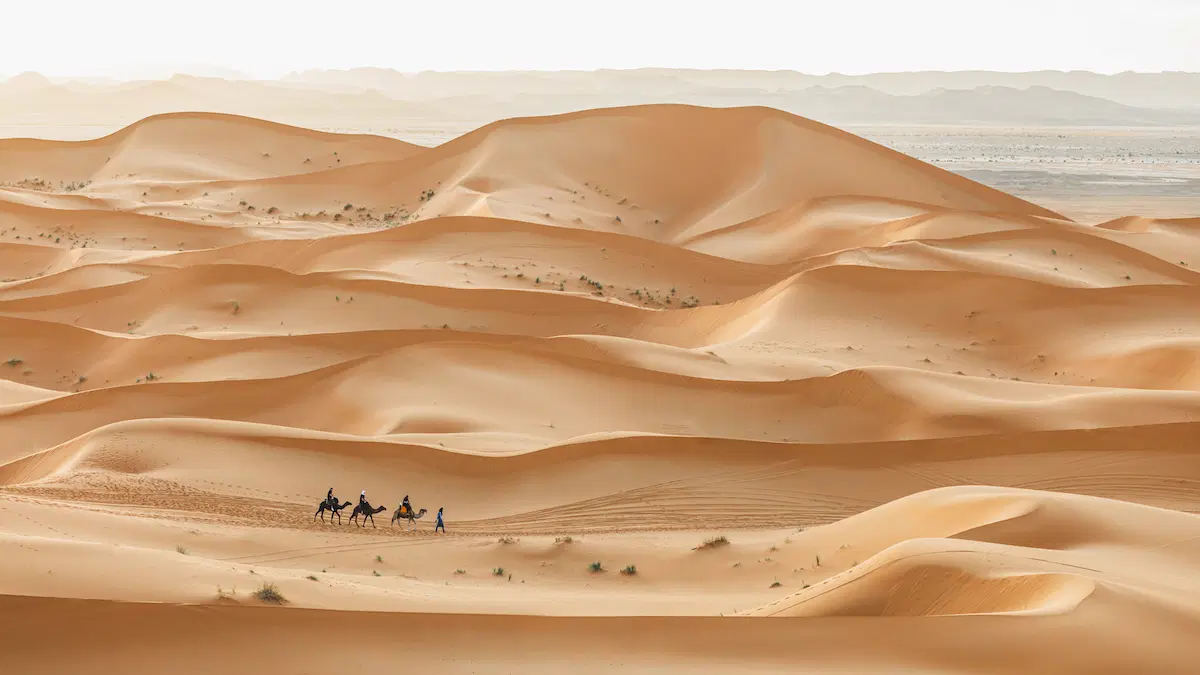
Erg Chigaga: The Complete Guide to Morocco’s Wild Sahara
You feel it before you see it. The road ends. The pavement disappears. Ahead, nothing but flat, stony desert stretching to a hazy horizon. This is where the tourist trail stops. This is Erg Chigaga.
While Erg Chebbi gets the crowds and the Instagram fame, Erg Chigaga is Morocco’s true desert wilderness. It is larger, wilder, and far less visited. The dunes here reach 300 meters high – twice the height of Erg Chebbi’s highest peaks. And you will likely have them almost to yourself.
This guide cuts through the marketing. You will learn exactly how to get there, what it costs, which camp type suits you, and whether the extra effort is worth it. For a broader overview, start with our complete guide to Sahara desert tours in Morocco.
What Is Erg Chigaga?
Erg Chigaga (also spelled Chegaga) is Morocco’s largest sand sea. It lies about 60 kilometers west of M’Hamid El Ghizlane, a small town that serves as the last outpost before the Sahara proper.
Unlike Erg Chebbi, which sits right off a paved highway, Erg Chigaga requires a real journey. You cannot drive there in a regular car. The last stretch is 60 kilometers of off-road piste – rocky hamada, dry lake beds, and soft sand tracks. This isolation is exactly why people come.
The dune field stretches approximately 40 kilometers in length and 22 kilometers in width. From the top of a high dune, you see nothing but sand rippling to every horizon. No buildings. No roads. No other tourists.
If you are new to Sahara travel, read our essential guide to traveling to the Moroccan Sahara before booking anything.
Quick Facts
- Location: 60km west of M’Hamid El Ghizlane, Draa-Tafilalet region
- Dune height: Up to 300 meters (980 feet)
- Distance from Marrakech: ~550km (8-12 hours driving, including off-road)
- Best time to visit: October to April
- Accessibility: 4×4 vehicle or multi-day camel trek only
- Nearest town: M’Hamid El Ghizlane
Erg Chigaga vs Erg Chebbi: Which One Is Right For You?
This is the most common question. Both are stunning. Both are “the real Sahara.” But they offer fundamentally different experiences. Our detailed Erg Chebbi guide covers the alternative in depth. Here is a direct comparison.
Side-by-Side Comparison
|
| Feature | Erg Chigaga | Erg Chebbi |
|---|---|---|
| Dune height | Up to 300m (larger, more varied terrain) | Up to 150m (more uniform, photogenic) |
| Accessibility | 60km off-road, 4×4 or camel only | Paved road to the edge of the dunes |
| Number of camps | ~20-30 camps | 200+ camps |
| Crowds | Few tourists, genuine solitude | Peak season can be very busy |
| Nearby facilities | None – just your camp | Shops, restaurants, hotels in Merzouga |
| Journey from Marrakech | 10-12 hours with off-road section | 8-9 hours, all paved |
| Best for | Adventure seekers, solitude lovers, second-time visitors | First-timers, families, short schedules |
The Honest Verdict
Choose Erg Chebbi if: You have limited time (3 days total), want the easiest access, need a wide range of camp options, or are traveling with young children.
Choose Erg Chigaga if: You have flexibility, prioritize solitude over convenience, are willing to spend more time in a vehicle, or have already visited Erg Chebbi and want something different.
One experienced traveler puts it simply: “If you are short on time or looking for maximum comfort, choose Merzouga. If you want to feel truly lost in the middle of nowhere, choose Erg Chigaga”.
Can you do both? Not realistically in one trip. Each requires 3 days minimum from Marrakech. Doing both would take 6 days of desert touring – possible but exhausting for most travelers.
When to Visit Erg Chigaga
Timing your visit is critical. For a broader look at Morocco’s seasons, see our best time of the year to visit Morocco.
Best Seasons: October-November & March-April
Daytime temperatures range from 20-28°C (68-82°F). Nights are cool but comfortable. Skies are clear. This is peak season for good reason.
Winter (December-February)
Days are mild (15-20°C / 59-68°F), but nights can drop below 5°C (41°F) and occasionally freeze. Fewer tourists, but bring serious warm layers – down jacket, beanie, gloves. Read our guide to visiting the desert in winter for more tips.
Summer (June-August)
Extreme heat. Daytime temperatures regularly exceed 40°C (104°F) and can hit 50°C (122°F). Many camps close during this period. Avoid unless you have desert experience.
Shoulder Months (May & September)
Hot but manageable. Late May exceeds 35°C (95°F). Early September still carries summer heat but cools by month’s end. Fewer crowds than peak season.
How to Get to Erg Chigaga
The journey is part of the experience. Here are your options, from easiest to most adventurous.
1. Book a Multi-Day Tour (Easiest)
Most first-timers choose this. A 3-4 day tour from Marrakech includes transport, guide, meals, camel trek, and camp stay. You do not have to plan anything.
Cost: €250-450 per person for a 3-4 day tour, depending on group size and camp type.
Typical 4-day itinerary: Marrakech → Aït Benhaddou → Draa Valley → M’Hamid → 4×4 to Erg Chigaga (overnight camp) → return via Lake Iriki → Marrakech.
2. Drive Yourself + 4×4 Transfer (More Control)
You can drive a regular car all the way to M’Hamid on paved roads. Park your car at a hotel or auberge in town. Then your camp will send a 4×4 to pick you up for the off-road section.
From Marrakech: 550km, 8-10 hours driving.
From Ouarzazate: 5-6 hours via the Draa Valley.
From Zagora: Taxis run every 30 minutes to M’Hamid (~1 hour).
4×4 transfer cost: Usually included in your camp booking. If not, expect 400-600 MAD ($40-60) round trip.
3. Public Bus (Cheapest)
CTM runs buses from Marrakech and Ouarzazate directly to M’Hamid. The journey is long but possible. Once in M’Hamid, arrange a 4×4 transfer to your camp.
Pro tip: Even if you take a bus, you will still need to book a camp and 4×4 transfer separately. For most travelers, the tour package is simpler.
4. Fly to Ouarzazate (Fastest but Pricey)
Ouarzazate Airport (OZZ) is about 5-6 hours from M’Hamid by road. Flights from Casablanca or Marrakech are available but limited. You will still need ground transport.
The Off-Road Journey: M’Hamid to Erg Chigaga
This is where the adventure begins. From M’Hamid, you will travel 60 kilometers across varied terrain. The journey takes 2-3 hours by 4×4, depending on conditions and stops.
The landscape changes in stages. First, a vast plain of dark stones and low hills. Then, dry lake beds like Lake Iriqui – a salt flat that, after rare rains, becomes a shallow lake attracting birds. You might spot fossils in the rock. Then, low bushes surrounded by sand. Finally, the sand takes over completely as you approach the giant dunes.
Experienced guides often stop along the way to show you hidden spots. This is not wasted time – it is part of the experience.
Important: Do not attempt this drive yourself without a 4×4 and local knowledge. There are no signs, no phone signal, and getting stuck is a real risk.
Before you go, check our general travel advice for Morocco for safety tips and cultural guidance.
Where to Stay: Camps and Accommodation
Erg Chigaga has far fewer camps than Erg Chebbi – roughly 20-30 in total. They range from basic to comfortable, but “luxury” here means something different than in Merzouga.
For a full breakdown of camp types, read our comparison of luxury vs standard Morocco desert camps.
Standard/Budget Camps (400-1,000 MAD / $40-100 per person)
Traditional Berber tents with mattresses on rugs over sand. Shared bathroom facilities – usually a separate block with squat or simple flush toilets and cold water. No electricity in tents; lighting from candles or solar lanterns. Meals are communal, eaten around a shared tagine.
Who it is for: Adventurous travelers, budget-conscious visitors, people who want the most authentic experience.
The real experience: You eat together, you drum around the fire together, you sleep under wool blankets. It is social, genuine, and memorable.
Mid-Range Camps (1,000-1,800 MAD / $100-180 per person)
Private or semi-private bathrooms. Better beds. Some have limited solar electricity for charging. More comfortable than basic camps, but still rustic.
Who it is for: Most travelers. This is the sweet spot of value and authenticity.
Luxury Camps (1,800-4,000 MAD / $180-400 per person)
Spacious tents with proper beds, quality linens, and en-suite bathrooms with flushing toilets and hot water. Some have private terraces and better food. A few offer unique features like the “Sandhammam” – a treatment where you are covered in warm Sahara sand.
Who it is for: Honeymooners, anyone wanting comfort without losing the desert experience.
Note: Even luxury camps are still camps. Generators run at night. Water pressure varies. WiFi is rare.
Wild Camping (Arranged through your guide)
Some guides offer wild camping – no permanent structures, just tents set up in a remote spot chosen for the night. This is the most authentic and isolated option.
Facilities: Very basic. “Desert toilet” means digging a hole. No shower. But the stars are unmatched.
Accommodation in M’Hamid
If you arrive a day early or want a proper shower after the desert, M’Hamid has several options:
- Dar Nomads: Comfortable rooms with private bathrooms, terrace, and garden.
- Oasis Source de Vie: Budget-friendly option surrounded by palm trees.
- Auberge La Palmeraie: Simple rooms in a peaceful palm grove setting.
A Day in Erg Chigaga: What Actually Happens
Day 1: Arrival and Sunset
You arrive in M’Hamid by early afternoon. Your camp will pick you up in a 4×4. The off-road journey to the dunes takes 2-3 hours, with stops at scenic points along the way.
You reach camp in the late afternoon. After traditional mint tea, you prepare for the camel trek. The ride lasts 45-90 minutes, taking you deeper into the dunes. You climb the last stretch on foot to watch the sunset from the highest dune.
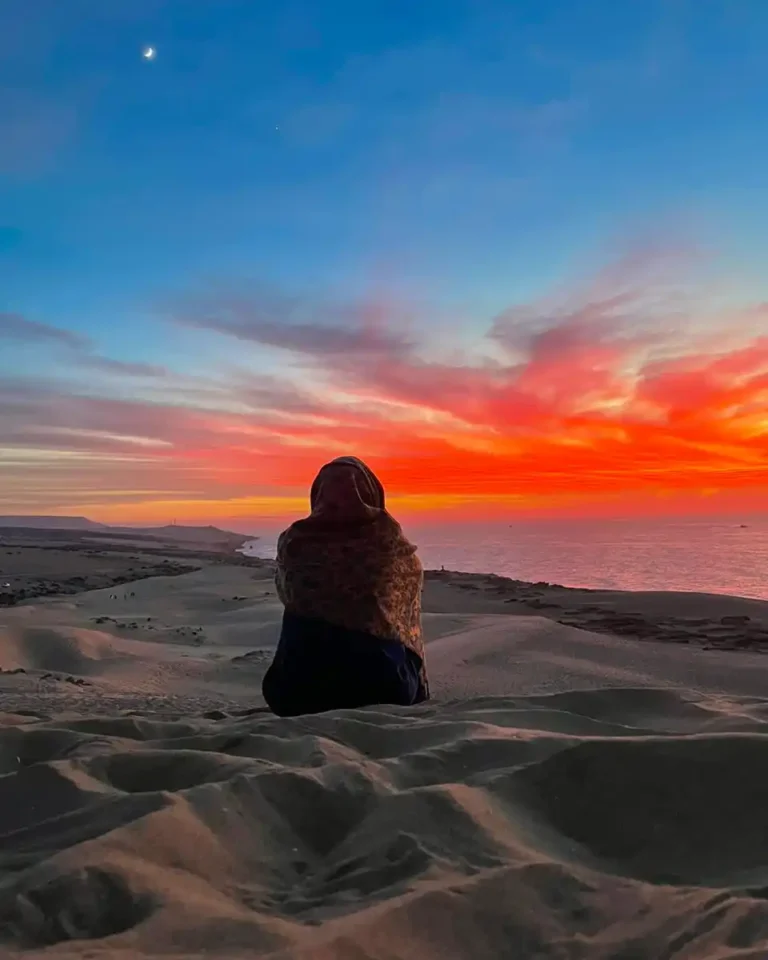
What you see: A sea of sand spreading beneath you. The light shifts from gold to amber to deep crimson. Time stops.
Evening: Dinner (tagine, couscous, salad). Then Berber music around the campfire – drums, hand claps, call-and-response songs. Then stargazing. The Milky Way arcs overhead with shocking clarity.
Sleep: In your tent. Or, if you prefer, outside on a mattress under the stars. Many travelers choose the latter.
Day 2: Sunrise and Return
Wake-up is early, often before 5 AM. The sunrise from the dunes is the highlight. Sand shifts from violet to rose to gold as the sun breaks the horizon.
Breakfast back at camp (bread, jam, cheese, mint tea). Then either camel ride back to the 4×4 or direct 4×4 transfer to M’Hamid.
Total time in the dunes: About 16 hours. It is short, but intense.
Staying Longer
You can stay 2 or 3 nights in the dunes. Extra days mean more time for 4×4 exploration, visiting nomadic families, hiking to different dune fields, or simply sitting in silence.
What Most Guides Do Not Tell You
- Cold nights: Even in April, nights can drop to 5°C (41°F). In winter, near freezing. You will need every blanket provided.
- Limited facilities: Basic camps have shared toilets and cold showers. Luxury camps have private bathrooms but water pressure varies.
- No phone signal: Zero. Download maps and emergency contacts before you go. Bring a power bank; charging is limited.
- The 4×4 ride is bumpy: The off-road journey is part of the adventure, but if you have back problems, consider Erg Chebbi instead.
- Sand gets everywhere: In your shoes, your clothes, your camera, your ears. Embrace it.
- The camel ride is short: Most treks are 45-90 minutes each way – enough for the experience, but not a multi-day expedition.
- Wind can be intense: Erg Chigaga is more exposed than Erg Chebbi. Sandstorms are possible, especially in spring.
Beyond the Dunes: Other Activities
- 4×4 exploration: Visit Lake Iriqui (dry salt flat), fossil beds, and old caravan routes.
- Sandboarding: Snowboarding on sand dunes. Most camps provide boards.
- Visit nomadic families: Meet Berber families living in the desert. Bring small gifts – sweets, school supplies, fresh fruit.
- Stargazing: With zero light pollution, Erg Chigaga has some of the darkest skies in Morocco.
- Photography expeditions: The varied terrain offers more compositional variety than Erg Chebbi.
What to Pack: The No-Nonsense List
Essential Gear
- Headlamp or flashlight: Camps are dark at night. Essential for bathroom trips.
- Power bank: Charging is very limited. Some camps have no electricity at all.
- Headscarf or shemagh: Protects against sun, wind, and sand. Essential during 4×4 rides.
- Closed-toe shoes: Camel riding in sandals equals regret. Sturdy sneakers work.
- Warm layer (down jacket or heavy fleece): Nights are cold year-round. Do not underestimate this.
- Warm hat and gloves: Winter only, but critical if you visit December-February.
- Sunscreen (SPF 50+): The desert sun is intense.
- Polarized sunglasses: Reduces glare off the bright sand.
- Lip balm with SPF: Lips crack quickly in dry desert air.
- Wet wipes: Showers are limited; these are a lifesaver.
- Small daypack: For your overnight essentials – leave main luggage at the auberge in M’Hamid.
- Reusable water bottle: Your guide will provide water, but extra is smart.
Clothing
- Long pants (camel riding chafes bare legs)
- Lightweight long sleeves (sun protection)
- Sandals or flip-flops (for walking around camp)
What Not to Bring
- Heavy hiking boots (sand gets in them, and they are overkill)
- Expensive jewelry (it will get sandblasted)
- Hard-sided luggage to camp (leave it at the auberge)
- Expectations of luxury (even luxury camps are still camps)
Photography Tips: Capturing Erg Chigaga
Erg Chigaga is a photographer’s dream, but different from Erg Chebbi.
Best Times
- Sunrise (5:30-7:00 AM, depending on season): The light is soft and golden. The dunes glow. This is the best time for photos.
- Sunset (6:00-7:30 PM): Deep reds and oranges. The dunes look like molten metal.
- Golden hour: The hour after sunrise and before sunset – warm light that sculpts dune ridges beautifully.
- Night: With zero light pollution, the Milky Way is visible to the naked eye. Bring a tripod.
Gear to Bring
- Wide-angle lens (captures the scale of the dunes)
- Telephoto lens (compresses distance, makes dunes look enormous)
- Tripod (essential for sunrise, sunset, and night shots)
- Lens cleaning kit (sand gets everywhere – bring a blower, not just a cloth)
- Plastic bags (seal your camera when not in use)
- Extra batteries (cold nights drain them faster)
Composition Tips
- Shoot from high ground – climb the tallest dune you can reach.
- Include a person or camel for scale – dunes look small without a reference point.
- Shoot into the light – backlit dunes have glowing edges.
- Look for patterns – wind-sculpted ripples, camel tracks, shadows.
- The varied terrain offers more compositional variety than Erg Chebbi – use the dry lake beds and rocky areas as foregrounds.
Cultural Etiquette and Practical Tips
Interacting with Berber Hosts
The desert camps are run by local Berber families. Here is how to show respect:
- Do accept mint tea when offered – it is a sign of hospitality.
- Do learn a few words of Tamazight: Azul (hello), Tanmirt (thank you).
- Do ask permission before photographing people, especially elders.
- Do bring small gifts for nomadic families if you visit – sweets, school supplies, fresh fruit are appropriate.
- Don’t give money directly to children (it encourages begging).
- Don’t expect nomadic families to “perform” for you – they are living their lives.
Tipping
Not actively solicited, but appreciated. Standard amounts:
- Camel guide: 20-50 MAD ($2-5)
- Driver/guide for multi-day tour: 50-100 MAD ($5-10) per day
- Camp staff: 20-50 MAD total
Health and Safety
- Getting lost in the dunes: Real risk. Always stay with your guide. Dunes shift constantly – no fixed landmarks.
- Dehydration: Bring water. Your guide will provide it, but extra is smart in summer.
- Sun exposure: Serious. Cover up, use sunscreen, wear sunglasses.
- Cold exposure: Underestimated risk. Nights are genuinely cold.
- Mobile reception: Very limited to nonexistent. Download maps and emergency contacts before you go.
- 4×4 safety: Experienced drivers ensure safety, but the off-road ride can be bumpy. If you have back problems, consider Erg Chebbi instead.
Solo Female Travelers
Erg Chigaga is generally safe for solo women. The remote location means fewer interactions with strangers. Luxury camps offer more privacy. Standard camps put you in a shared environment, which some solo travelers find socially more secure. Reputable operators have respectful staff. Book through a trusted agency.
Sample Itineraries
3-Day Quick Trip from Marrakech (Minimum Time)
Day 1: Marrakech → Aït Benhaddou → Draa Valley → M’Hamid (overnight in auberge)
Day 2: M’Hamid → 4×4 to Erg Chigaga → Camel trek → Sunset → Camp (overnight in dunes)
Day 3: Sunrise → Return to M’Hamid → Drive back to Marrakech
Best for: Travelers with limited time who still want the Erg Chigaga experience. The drive is long but the desert time is real.
If you are interested in organized private tours, you can check our 3-Day Marrakech to Sahara desert private tour, or Fez to Marrakech through the desert tour.
4-Day Relaxed Trip from Marrakech (Recommended)
Day 1: Marrakech → Aït Benhaddou → Ouarzazate → Draa Valley (overnight in hotel)
Day 2: Draa Valley → M’Hamid → 4×4 to Erg Chigaga (arrive afternoon) → Camel trek → Sunset → Camp
Day 3: Sunrise → Optional activities (4×4 exploration, sandboarding, nomadic visit) → Second night in camp or return to M’Hamid
Day 4: Return to Marrakech
Best for: Most travelers. This gives you a full day in the dunes and a more relaxed pace.
2-Day Wild Camping from M’Hamid (For Adventurers)
Day 1: M’Hamid → 2-day camel trek toward Erg Chigaga → Wild camp under stars
Day 2: Continue trek → Arrive Erg Chigaga → 4×4 return to M’Hamid
Best for: Travelers who want the most authentic desert experience. This is the classic nomadic way.
Budget Breakdown: What Things Actually Cost (2026)
- 3-day tour (per person): Budget 2,000-2,400 MAD ($200-240), Mid-range 2,400-3,000 MAD ($240-300), Luxury 3,000-4,500 MAD ($300-450)
- Desert camp (per night): Budget 400-800 MAD ($40-80), Mid-range 800-1,800 MAD ($80-180), Luxury 1,800-4,000 MAD ($180-400)
- Camel trek: Usually included in camp price
- 4×4 transfer M’Hamid to camp (round trip): Usually included. If not, 400-600 MAD ($40-60)
- Sandboarding: 50-100 MAD ($5-10) or often included
- Quad biking: Not common in Erg Chigaga – fewer operators offer this
- Lunch on tour (per meal): 80-120 MAD ($8-12)
- Tip for guide (per day): 50-100 MAD ($5-10) budget/mid-range, 100-150 MAD ($10-15) luxury
- Tip for camel guide: 20-50 MAD ($2-5)
What is usually NOT included: Lunches, bottled water (beyond what is provided at camp), soft drinks or alcohol, tips, optional activities.
Payment: Most tours require a deposit via bank transfer or PayPal, with the balance paid in cash (MAD or EUR) to your guide upon arrival.
Note on pricing: Erg Chigaga tours often cost slightly more than comparable Erg Chebbi tours because fewer operators offer them and transport is longer.
The Honest Verdict: Is Erg Chigaga Worth It?
Yes. With specific caveats.
Erg Chigaga delivers something Erg Chebbi cannot: genuine solitude. The feeling of standing on a dune at sunset with no other humans in sight is rare in 2026. The stars are darker. The silence is deeper. The adventure of getting there is part of the memory.
But go in with open eyes. The journey is longer. The camps are fewer and more basic. If something goes wrong, you are further from help. The wind can be intense. This is not the “easy” Sahara.
One traveler captures it well: “Erg Chigaga is for the wild at heart. It lies far off the beaten track. The dunes here are more expansive and rugged, the stargazing is unparalleled, and you will likely see more camels than tourists. If you want that untouched, remote desert feel, this might be your spot”.
Choose Erg Chigaga if: You have a flexible schedule, prioritize solitude over convenience, are willing to spend more time in vehicles, or have already visited Erg Chebbi and want something different.
Choose Erg Chebbi if: You are a first-time visitor, have limited time (3 days total), need a wide range of camp options, or are traveling with young children.
Just go. Whether you choose Chigaga or Chebbi, the Sahara will change how you see the world.